The Islamic World Educational, Scientific
and Cultural Organization (ICESCO) has signed a joint Memorandum of Understanding
with Hewlett-Packard (HP), Classera and Mirai for cooperation in implementing
education programs in the countries of the Islamic world, aiming to build a new
educational model that will support distance learning, contribute to the
development of the digital transformation process in education and promote
digital education.
The memorandum was signed by Ambassador Khaled Fathalrahman, Supervisor of the Partnerships and International Cooperation Sector at ICESCO, Mr. Salah Ouardi, Director General of HP Morocco, Mr. Mahmoud El-Gabry, Director of International Partnerships at Classera, and Ms. Christine Carlin Nasser Qudsi, Co-Director of Mirai.
The MoU aims to provide a set of teaching
materials to develop skills in information culture and to provide systems for
managing the learning process, information systems for students, a digital
library, and virtual solutions. It also aims to develop digital teaching and learning,
and strategies for mastering distance learning.
The provisions of the MoU include
cooperation in achieving the common goals through several means such as exchanging
of information and experiences between the different parties, sharing expertise
in training, improving national educational data systems in the ICESCO Member
States, as well as providing models for optimal experiences and establishing
development centers for digital transformation in the Member States.
The Islamic World Educational, Scientific and Cultural Organization
(ICESCO) participated in the Regional Workshop on Capacity Building of Teacher
Policy Development in Africa that the United Nations Educational, Scientific
and Cultural Organization (UNESCO) held, on Wednesday (7 July 2021), via videoconferencing, in
cooperation with UNESCO International Institute for Capacity Building in Africa
(IICBA) and the International Task Force on Teachers.
The workshop aimed to enhance the participants’ knowledge concerning
the process of teachers policies development and ways to improve the relevant efforts,
provide various useful resources and tools, create a platform for educational
specialists in regional offices and other stakeholders to share the best
practices and challenges when providing technical support for developing teacher
national policies.
During this workshop, Dr. Barry Koumbou, Head of Education Sector
at ICESCO, reviewed the experiences and efforts of ICESCO in supporting the African
countries to develop their educational systems. She pointed out that education
systems in Africa today face challenges of quality, governance, and financing.
Dr. Koumbou called for developing teacher policies in Africa in a
gender-sensitive manner, stressing the importance of developing effective
mechanisms for collecting information and statistics relevant to teachers, and providing
the necessary funding for education while ensuring sound management and
commitment to transparency and good governance. Besides, she called for taking
care of refugees, women and people with disabilities without bias or
discrimination.
Moreover, Dr. Koumbou stressed the need to build the capacity of
teachers according to new ICTs methods, taking into account the African
cultures, including history, art, poetry, literature, languages and customs.
In cooperation with the Ministry of Haboos and Islamic Affairs of
the Kingdom of Morocco and the Library of Al-Qarawiyyin University, the Islamic
World Educational, Scientific and Cultural Organization (ICESCO) is hosting, at
its headquarters in Rabat, a first of its kind exhibition of rare historical
manuscripts spanning various fields of knowledge and featuring a treasure trove
of Al-Qarawiyyin University Library’s most prized possessions.
The exhibition, which opens today, Wednesday 7 July 2021, features
more than 20 rare manuscripts including a copy of the Holy Quran in the Kufi
Script without dots or diacritical marks, which dates back to the third century
A.H.; an Arabic version of the Gospel of Luke from the fifth century A.H.; and Kitab
Az-Zohd by Abu Daoud As-Sejestani. The exhibition also displays Al-Hidaya
Fi Tawhid by Al-Qadi Al-Baqalani; Al-Muwattaa by Yahya bin Mohamed
bin Abbad Al-Lakhmi, which dates back to the sixth century A.H.; Al-Mukhtassar
Al-Fiqhi by Abu Musaab Al-Zahri; Al-Jamiaa Al-Sahih by Muhammad bin
Ibrahim; Al-Bayan Wa Tahssil by Ibn Rushd Al-Jadd, a copy made for the
Sultan; Jarru Ath-Thayl Fi Ilm Al-Khayl by Jalal Dine As-Sayuti; and the
Book of Ethics by Aristotle. Likewise, the exhibition includes a manuscript on
astronomy that was written by Ptolemy and translated by Al-Farabi, in addition
to a selection of knowledge treasures in various fields including religious
sciences, astronomy, medicine, philosophy, and history authored by prominent
science and intellect figures from the Islamic world and abroad.
The exhibition is open to visitors, concurrently with the ICESCO
Scientific Symposium on the release of the First Volume of the Encyclopedia of
Deconstructing Extremist Discourse. The Symposium was held in cooperation with
the Mohammadia League of Scholars of the Kingdom of Morocco, as part of the
Framework Partnership Agreement between ICESCO and the League aiming to
intellectually shield the Muslim youth against the different forms of extremist
and hate discourse in the Islamic world and beyond.
On the sidelines of the exhibition, a team specializing in
manuscript restoration from the Manuscript Restoration Lab at Al-Qarawiyyin
University will give a practical demonstration to visitors on the latest trends
in manuscript restoration using advanced technology.
Al-Qarawiyyin Library in Fez is one of the oldest heritage libraries
in Morocco. It was established in 750 A.H. and has been subject to numerous restoration
and repair operations. The library has maintained its key role in the fields of
science and knowledge, making it a reliable destination for researchers and
students. Its collection has been enriched by Sultans, princes, and scholars who
donated rare and invaluable books.
With high-level participation of officials, diplomats, intellectuals,
scholars and specialists in combating extremist ideology, the Islamic World
Educational, Scientific and Cultural Organization (ICESCO) and the Mohammadia
League of Scholars, on Wednesday (7 July 2021), launched the first volume of
the Encyclopedia on Deconstructing the Discourse of Extremism, entitled “Deconstructing
the intellectual backgrounds of the discourses of extremism,” which is part of
the partnership agreement between ICESCO and the League, for protecting Muslim
youth from the various forms of the discourse of extremism and hatred inside
and outside the Islamic world.
ICESCO presented the first volume during a major scientific
symposium, at its headquarters, in Rabat, which began with the recitation of
verses from the Holy Qur’an; then Dr. Salim M. AlMalik, ICESCO Director
General, gave a welcome address wherein he reaffirmed that terrorism has become
a worrisome phenomenon that obscures the major goals of our existence, which
consist in peacebuilding, calling for strengthening this value to become a source
of inspiration by spreading peace to become a central concept.
Besides, Dr. AlMalik noted that the Organization and the League
issued this encyclopedia to invest in all the scientific efforts made in
addressing the misinterpretations of religious texts to serve as a reference
for researchers, scholars, university institutions, research centers,
specialized observatories and international organizations to address the
effects of extremism around the world.
Dr. Ahmed Abbadi, Secretary-General of Mohammadia League of
Scholars, gave the main lecture, wherein he stated that the encyclopedia aims
to protect young people from the discourse of extremism as well as other related
concepts. “The encyclopedia is based on the idea that religion aims to develop secure
societies. The first volume of this encyclopedia is an introduction to the fundamental
concepts of the complex phenomenon of extremism, while the second volume deals
with the tools for deconstructing the discourse of extremism. The third volume
takes into account the nature of the current reality. Moreover, there is a
conflict between the real and the digital world. Thus, it is essential to have an
expert in the digital field for countering the extremist ideology because its
promoters are strongly active in the digital space,” he underscored.
Afterward, the participants and attendees expressed their views during which Dr. Driss Fassi Fihri, Al-Qarawiyyin University Vice-President, stated that deconstructing extremist discourse entails identifying the components under which radical ideas are being disseminated.
Mr. Mohammed Ben Ayed, Ambassador of Tunisia to Morocco, noted that Islam, a religion of moderation and middle stance, urges people to use reason. “Extremism is an extremely complex and dangerous phenomenon that can severely impact humanity. The encyclopedia touches upon the different aspects of such phenomenon,” added Mr. Ben Ayed.
For his part, Dr. Ahmad Sennouni, Assistant Secretary-General of
Mohammadia League of Scholars, praised the encyclopedia as it provides a
detailed description of the changes Muslim communities have undergone and has a
clear vision for deconstructing extremist discourse. While Dr. Farida Zoumroud,
a Member of the Executive Board of Mohammadia League of Scholars, explained
that criticism is one of the most important means to countering extremism since
extremists usually seek religious pretexts for their acts through
misinterpretation of texts. She also added that the encyclopedia strives to
correct some misconceptions for deconstructing extremist discourse while
analyzing its psychological dimension.
Dr. Abdelilah Benarafa, ICESCO Deputy Director-General, moderator
of the Symposium, noted that Islamic civilization is the source of science and
knowledge. “Understanding Arabic language and the connotations of the word
“terrorism” is a key element to deconstructing extremist discourse; Al-Munjid
dictionary was one of the first dictionaries to include the word terrorism back
in 1960,” he added.
At the close of the symposium, Dr. AlMalik delivered a closing
address wherein he praised all the efforts that contributed to bringing the
encyclopedia into existence and thanked all the attendees and participants. He
also noted that the Organization works toward incorporating the concept of
peace into the primary level educational curriculum, which will be part of its
recommendations during conferences and meetings with Member States’ education
ministers.
On July 5, 2021, in Fez, King Mohammed VI of Morocco attended the
signing ceremony of three agreements to launch the project of manufacturing and
packing COVID-19 vaccine as well as other vaccines, in partnership with
international companies, including the Swedish company (Recipharm), which is
the fifth largest pharmaceutical manufacturer worldwide, the Chinese company
“Sinopharm” and the Société de Thérapeutique Marocaine (Sothema).
This project will ensure self-sufficiency, enhance health security
and make the Kingdom of Morocco among the major regional and international
platforms in the pharmaceutical and biotechnological industries.
Within the framework of the royal solidarity vision, the African and
sister countries will benefit from this project, particularly that the COVID-19
crisis has shown stark disparities between countries in access to vaccines,
medicines, masks, and means of disinfection in what has become known as the
“vaccine war.”
In its first phase, this project will produce 5 million vaccines
per month while seeking to double the production capacity in the medium term,
with a total investment value of $500 million.
This leading royal initiative comes amid the global crisis
triggered by the COVID-19 pandemic that has largely affected the fields of
education, culture, science and other vital sectors. It aims to give hope to
those suffering in times of crisis to achieve gains and accomplish the
necessary transformations.
On this occasion, the Islamic World Educational, Scientific and
Cultural Organization (ICESCO) is pleased to congratulate the Kingdom of
Morocco on this great scientific and industrial achievement, calling on the Member
States to cooperate to achieve health security for the benefit of Muslim
peoples.
Dr. Salim M. AlMalik, Director-General of the Islamic World
Educational, Scientific and Cultural Organization (ICESCO), and Dr. Farhan
Nizami, Director of the Oxford Center for Islamic Studies, explored the prospects
of wider cooperation between the Organization and the Center, especially in the
fields of building youth’s capacities, scholarships, scientific research and
ICESCO Academic Chairs.
During the meeting, held today, Tuesday 6 July 2021, via
videoconference, the two parties expressed their keenness to promote
partnership between ICESCO and the Center, reaffirming the importance of
developing cooperation in the field of conducting specialized studies and
implementing practical and goal-oriented programs and activities within the two
institutions’ shared areas of interest.
Dr. AlMalik noted that ICESCO’s new vision and action strategy
positions peace at the forefront of its priorities, highlighting the
Organization’s numerous programs in this regard including the Program of Training
Young Leadership for Peace and Security. He added that ICESCO opened up to
world countries, regional and international organizations, and bodies and civil
society institutions by capitalizing on its Academic Chairs Program. He further
explained that in addition to chairs at universities and research centers within
the Islamic world, the Program provides for setting up chairs in prominent
universities outside the Islamic world in countries such as Germany and Brazil.
Dr. Nizami expressed his delight to explore cooperation prospects
with a major organization such as ICESCO, which enjoys great presence and
outreach within the Islamic world, conveying his honor to take part in ICESCO
Conference on the Civilizational Values in the Prophet’s Seerah, held on 27 May
2021. He also reaffirmed that cooperation between ICESCO and the Center must
keep up with the current changes and consider the values of quality and
continuity in view of achieving the set goals, noting that joint action is the way
to making a difference.
The meeting saw the participation of senior ICESCO officials,
namely Dr. Abdelilah Benarafa, ICESCO Deputy Director-General, Ambassador Khalid
Fathalrahman, Director of the Center for Civilizational Dialogue, and Dr. Said
Bah, Advisor to the Director-General for Partnerships and International
Cooperation.
The Oxford Center for Islamic Studies is an Oxford
University-affiliated research center. It was created in 1985 under the
patronage of H.R.H. Prince Charles, Prince of Wales. The Center aims to
encourage Islamic studies and it is the first center in British history to specialize
in this kind of study under the patronage of a member of the British Royal
Family.
The Islamic World Educational, Scientific, and Cultural
Organization (ICESCO), in partnership with the Mohammadia League of Scholars, will
hold a scientific symposium to introduce the first part of “the Encyclopedia on
Deconstructing Extremist Discourse” which was prepared under the framework of
the partnership agreement signed between the Organization and the League to protect
Muslim youth against various forms of extremist discourse within and outside the Islamic
World.
The Symposium, due to be held on Wednesday (7 July 2021), both at ICESCO headquarters, in Rabat, and
through videoconferencing, will start at 10:00 UTC (11.00 Rabat time) with the
recitation of verses from the Holy Quran, followed by a welcoming address of
Dr. Salim M. AlMalik, ICESCO Director-General (DG). Afterward, Dr. Abdelilah
Benarafa, ICESCO Deputy Director-General, will give a general overview of the Symposium.
Dr. Ahmed Abaddi, Secretary-General of Mohammadia League of Scholars, will deliver the main lecture, which
will include a definition of the encyclopedia and its characteristics and distinctive
components.
The encyclopedia, the first part of which
was completed, is the first scientific initiative that aims to monitor and
deconstruct the various forms of zealotry and extremism in Muslim countries and
highlight the aspects of misinterpretation and misuse of many religious
concepts to sow division and spread a distorted image about the teachings of
Islam across the world.
The first part of the encyclopedia lays out
the theoretical framework for dismantling the intellectual backgrounds of
extremist discourses through several academic research works under the four
following themes:
• Deconstruction
of extremist discourse: Concepts and methodology
• Deconstruction
of the intellectual backgrounds of extremist discourse
• Refutation
of the foundations of extremist discourse
• Critique
of the extremist discourse
You
can follow the live streaming of the Symposium on the official Facebook page of
ICESCO via the link below:
the Islamic World Educational, Scientific and Cultural Organization
(ICESCO) and Talal Abu-Ghazaleh Foundation, today (5 July 2021), held a meeting
to explore the joint programs and activities, especially in the field of
artificial intelligence, scientific research, digital education and strategic
foresight.
The meeting, held via videoconferencing, brought together Dr. Salim
M. AlMalik, ICESCO Director-General, and Dr. Talal Abu-Ghazaleh, President of
Talal Abu-Ghazaleh Foundation, as well as Dr. Kais Hammami, Head of ICESCO
Center for Strategic Foresight, Dr. Mushira Eneizat, International Cooperation
and External relations Executive Director at Talal Abu-Ghazaleh Foundation, and
Ms. Rim Jalloul from ICESCO Strategic Foresight Center.
At the outset of the meeting, Dr. AlMalik reviewed the main axes of
ICESCO’s vision and action strategy, which are based on renewal, modernization
and openness for the benefit of the Member States and Muslim communities around
the world, stressing that ICESCO is keen to cooperate with Talal Abu-Ghazaleh Foundation.
Dr. AlMalik also stated that there are many potential areas of
cooperation, including strategic foresight, artificial intelligence, digital
education, scientific research, and ICESCO scientific chairs, which are vital
areas for Muslim countries.
For his part, Dr. Abu-Ghazaleh emphasized the importance of
renewing education methods in the Islamic world to develop scientific research
and encourage creativity and invention to contribute to building a creative
nation. He also underlined the urgent need to establish ethical oversight on
artificial intelligence, underlining his willingness to cooperate on issuing a dictionary
of artificial intelligence terms.
Besides, he stressed Talal Abu-Ghazaleh Foundation’s keenness to
cooperate with ICESCO, stating: “We are proud to be your partner.”
Moreover, the two parties agreed to nominate two coordinators to
ensure effective communication and follow up to the expert meetings in the
areas of cooperation to develop operational plans for practical initiatives,
programs and activities that achieve a tangible impact.
The Islamic World Educational, Scientific, and Cultural
Organization (ICESCO) have approved funding for a set of projects for the
benefit of the State of Palestine, which will be implemented in the second half
of 2021, in partnership with the Palestinian National Commission for Education,
Culture, and Science. The 9 projects covering the Organization’s action areas
in education, science and culture will benefit all Palestinian geographical
locations in northern and southern governorates as well as rural communities while prioritizing and paying
special attention to Al-Quds Al-Sharif, which is being subjected to all forms
of systematic violations and attacks by Israeli Occupation.
Dr. Salim M. AlMalik, ICESCO
Director-General, underscored the Organization’s commitment to supporting the
sectors of education, culture and science in Palestine, noting that ICESCO’s contribution
to such projects is in support of the Palestinian cause in light of the fierce
violations committed against Palestinians, especially the recurrent violations
targeting Al-Quds Al-Sharif, including Al-Aqsa Mosque, Church of the
Holy Sepulcher, as well as the forced expulsion of Palestinians from their
homes in Sheikh Jarrah as in other regions of Al-Quds.
Dr. Ali Zeidan
Abu Zuhri, Head of the Palestinian National Commission for Education, Culture
and Science, member of the Executive Committee of the Palestine Liberation
Organization, thanked ICESCO Director-General for the Organization’s prompt approval of the
Palestinian project proposals for 2021, which were the product of joint efforts
and coordination with official partners, including ministries, government
institutions, and competent civil society institutions.
Besides, Dr. Abu
Zuhri underlined the importance of working in coordination with competent
partners for the project and program implementation, which focus on ICESCO’s
main areas of action, catering to people with special needs, media development,
women empowerment, artificial intelligence and technical education, music
therapy and supporting rural communities. He also praised ICESCO’s initiative
for increasing the number of scholarships awarded to Palestinian university
students.
Dr. Abu Zuhri
stated that operating under the umbrella of ICESCO provides Palestine with a
valuable opportunity to develop programs and projects in line with the
Organization’s priorities, orientations, and national priorities in light of
the current challenging circumstances. He
added that obtaining the maximum funding that the Organization may allocate to
its State Members bears witness to the high level of professionalism,
partnership, and coordination in preparing program and project files, which was
carried out through National Commission teams, in cooperation with relevant
national partner institutions, including government and civil society organizations.
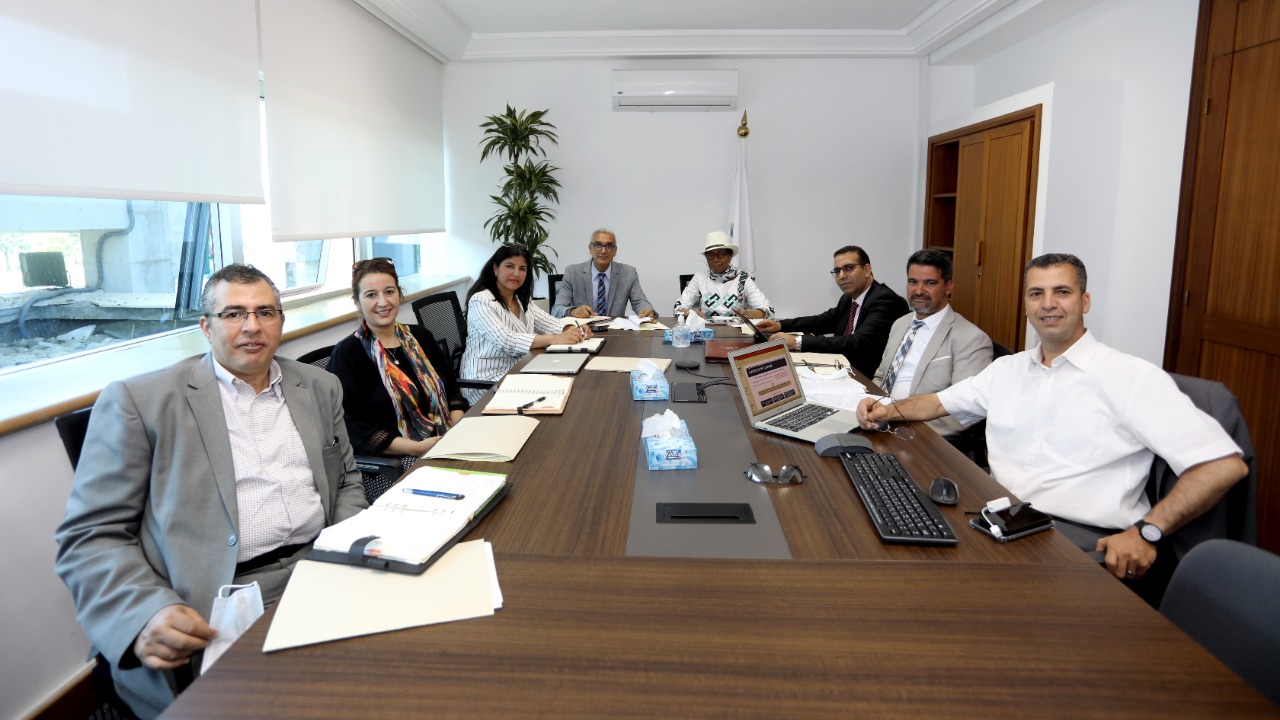
The Islamic World Educational, Scientific and Cultural Organization
(ICESCO) held a meeting with a team of educational experts from the Faculty of
Education (FSE) of Mohammed V University in Rabat, to prepare for the launch of
the “Project for the Development of an Elementary Education Model in the
Kingdom of Morocco,” in cooperation between ICESCO, the Islamic Development
Bank (IsDB) and the Moroccan Ministry of National Education, Vocational
Training, Higher Education and Scientific Research.
During the meeting, held on Friday, 2 July 2021 at ICESCO
headquarters in Rabat, the participants discussed a presentation made by the
team of experts, concerning the components of the project and the modalities of
its implementation, which consist of preparing and experimenting with three new
models in the educational system, namely: a model of new teaching methods for
students and educational executives; a new model for governance and management
of educational institutions; and a model determining the quality resources and
tools necessary for implementation.
During the meeting, Dr. Koumbou Barry, Head of ICESCO’s Education
Sector, and Mr. Aziz El Hajir, Specialist in Information and Communication
Technologies for Education, underlined the importance of this project as a
pioneering initiative that focuses on an innovative educational model with a
new vision of the concept of inclusive elementary education, which will benefit
the Kingdom of Morocco and the ICESCO Member States, prioritizes vulnerable
groups, especially girls in rural and remote areas, and includes the concepts
of lifelong learning and change management.