Disclaimer: You are using Google Translate. The ICESCO is not responsible for the accuracy of the information in the translated language .

your opinion

User Feedback

Overall, how satisfied are you about the website?

    Extremely Dissatisfied Extremely Satisfied

    Third Edition of the Forum of Academic Chairs Affiliated with International Organizations Held in Rabat with ICESCO’s Participation

    The Moroccan capital, Rabat, hosted the third edition of the Forum of Academic Chairs affiliated with international organizations, which was organized by the Islamic World Educational, Scientific and Cultural Organization (ICESCO) in collaboration with the Moroccan National Commission for Education, Science and Culture and the United Nations Educational, Scientific and Cultural Organization (UNESCO), as well as a number of concerned international organizations, in the presence of experts, academics, and representatives of universities and research institutions.

    Held on Wednesday, April 8, 2026, the meeting, themed “Academic Chairs in the Service of Society,” aimed to strengthen coordination and communication among academic chairs affiliated with international organizations, as well as share expertise and successful experiences. This will contribute to enhancing their performance and expanding their influence in the fields of knowledge and development.

    During the forum, Dr. Ahmed Albanyan, Director of ICESCO’s Translation and Publishing Centre, gave a presentation on ICESCO’s model for academic chairs. He outlined the governance pillars, impact measurement mechanisms, and partnership-building methods with universities and academic institutions.

    Dr. Albanyan emphasized that developing this model would enhance the effectiveness of the Chairs and consolidate their developmental and knowledge-based role, thereby ensuring their contribution to addressing priority issues within Member States.

    Dr. Salim Al-Habsi, Director of the General Secretariat for National Commissions and Conferences at ICESCO, also took part in the Forum’s sessions, stressing the importance of coordinating efforts between national commissions and academic and research institutions to enhance the performance of the scientific chairs and expand their scope of influence. He stressed the need to make these chairs effective platforms for linking scientific research to the needs of society and public policies.

    The Forum addressed a range of topics related to the role of academic chairs in supporting scientific research, strengthening academic partnerships, and transforming knowledge into practical solutions with a direct impact on society, before concluding with the issuance of recommendations calling for support for the system of research chairs, the development of their operational mechanisms, and the enhancement of their contribution to knowledge production.

    ICESCO to inaugurate the Sultan Qaboos Library at its headquarters in Rabat on April 16th

    The Library offers nearly 200,000 digital publications and 6,000 print books, and houses rare manuscripts

    Rabat: 9 April 2026

    The Islamic World Educational, Scientific and Cultural Organization (ICESCO) will inaugurate the Sultan Qaboos Library at its headquarters in Rabat on Thursday, 16 April 2026. This initiative reflects the Organization’s commitment to promoting knowledge, expanding cultural and scientific spaces, supporting research, and facilitating access to knowledge resources.

    The establishment of this knowledge landmark comes as a result of cooperation between ICESCO and the Sultanate of Oman, which contributed to supporting the project that bears the name of Sultan Qaboos—may Allah rest his soul in peace—in recognition of his contributions to the support of culture and science, as well as the role of the Sultanate of Oman in promoting cultural initiatives across the Islamic world. This Library is part of ICESCO’s knowledge work system, under the management of the Translation and Publishing Center.

    The Library inauguration ceremony will be accompanied by a symposium organized in cooperation with the Omani National Commission for Education, Culture and Science. The symposium will address the role of libraries in transferring knowledge and promoting translation and publishing, as well as highlighting the contributions of cultural diplomacy and cooperation relations between cultural institutions in both the Islamic and international spheres.

    The Library offers a modern space for reading and research, combining print and digital resources to provide researchers, students, and those interested in cultural and scientific issues with access to knowledge sources. In its initial phase, the Library houses over 6,000 print titles, along with a digital collection offering nearly 200,000 titles available through ICESCO’s digital platform. This collection is part of an initial phase that will be further developed through the integration of the digital library with broader knowledge systems and databases.

    It also includes rare documentary treasures, including a copy of the Holy Quran written in the handwriting of Ibn al-Bawwab, the Kairouan parchments, which are historical manuscripts, as well as a deluxe edition of the book “Al-Masjid Al-Aqsa” in a limited release.

    Moreover, the Library provides a dedicated space for children, aimed at fostering a love of reading and enhancing their cultural awareness by linking knowledge with human values and sustainable development issues, in line with ICESCO’s approach to building early knowledge awareness among future generations.

    For more details:
    ICESCO Digital Library:
    https://library.icesco.org/en

    Contact:
    PLD@icesco.org

    ICESCO Participates in “GITEX Africa Morocco” For the Fourth Consecutive Year

    The Islamic World Educational, Scientific and Cultural Organization (ICESCO) is participating in the fourth edition of the “GITEX Africa Morocco” exhibition, held from 7 to 9 April 2026, under the High Patronage of His Majesty King Mohammed VI, in the city of Marrakech, Kingdom of Morocco, under the theme: “Catalyzing Africa’s Digital Economy in the Age of Artificial Intelligence.” The event is witnessing remarkable attendance, bringing together around 50,000 participants and more than 1,450 exhibitors representing 130 countries.

    ICESCO’s participation in Africa’s leading event dedicated to technology, innovation, and entrepreneurship crowns its continued presence for the fourth consecutive year. This participation, overseen by ICESCO’s Department of Digital Transformation, reflects the Organization’s firm commitment to positioning the countries of the Islamic world at the forefront of the global digital revolution, enhancing the capacities of young talent, and accelerating comprehensive and sustainable technological development in its Member States.

    Furthermore, this participation is marked by the organization of three high-level sessions in the exhibition’s main hall, which will highlight the strategic importance of integrating technology into educational systems, explore pathways to achieving digital equity, and emphasize the urgent need to ensure that the most vulnerable groups are not left behind in the course of digital advancement.

    Members of ICESCO’s Department of Digital Transformation are also actively participating in multiple workshops, reflecting the Organization’s commitment to embedding its young talents at the heart of the startup and innovation ecosystem.

    Since the inaugural edition of the exhibition, ICESCO has stood out as an active institutional partner, embodying a strategic vision that recognizes that meaningful digital transformation in the Islamic world requires sustained investment and inclusive platforms that bridge the gap between leadership and the emerging generation of innovators.

    In this context, ICESCO commends the exceptional development witnessed by the exhibition, which is rapidly evolving into one of the most important strategic technological gatherings on both the African and global scenes. This reflects the capacity of the Kingdom of Morocco to host major events, foster innovation, and lead with a forward-looking vision toward the future.

    ICESCO, Cambridge University Press & Assessment Sign Cooperation Agreement to Develop Educational Systems in the Islamic World

    Dr. Salim M. AlMalik, Director-General of the Islamic World Educational, Scientific and Cultural Organization (ICESCO), attended the signing ceremony of a Memorandum of Understanding between the Organization and Cambridge University Press & Assessment (a department of the University of Cambridge) on Wednesday, 8 April 2026, at ICESCO headquarters in Rabat. The agreement aims to strengthen educational systems in ICESCO Member States through the development and implementation of a range of activities and programs in the fields of education, green education, and modern technology.

    The MoU was signed on behalf of ICESCO by Dr. Abdelilah Benarafa, Deputy Director-General, and on behalf of the University of Cambridge by Professor Bhaskar Vira, Pro Vice-Chancellor for Education and Environmental Sustainability, at the University of Cambridge, in the presence of several ICESCO officials and members of the university delegation.

    The memorandum provides for the development of joint programs aimed at strengthening educational systems in ICESCO Member States and their outcomes, building the capacities of staff working in government institutions and education specialists, cooperating in the implementation of initiatives to develop green education curricula, contributing to the alignment of national curricula and the promotion of educational practices in accordance with international standards, as well as exchanging knowledge to foster innovation in education and consolidating constructive dialogue with countries of the Islamic world.

    Following the signing ceremony, the two sides held an expanded meeting during which Dr. AlMalik affirmed that the technical expertise of the University of Cambridge, combined with ICESCO’s in-depth knowledge of the needs and priorities of its Member States, would contribute to the development of a number of programs and projects with tangible impact in the fields of education, science, culture, and innovation.

    The Director-General reviewed ICESCO’s strategic plan for the Education Sector, which is based on the principles of inclusiveness and integration, noting that the Organization adopts an open approach aimed at building partnerships with institutions, universities, and research centers from within and beyond the Islamic world.

    For his part, Professor Vira emphasized the importance of exchanging expertise between the two sides to develop education and promote innovation so that educational systems can keep pace with the challenges of the modern era, particularly in light of the changes the world is witnessing across various fields.

    The two sides agreed to explore ways and mechanisms to establish a joint scholarship program between ICESCO and the University of Cambridge for the benefit of students from the Organization’s Member States, in addition to conducting a case study on ICESCO’s success story as an innovative organization in its fields of action.

    The meeting was attended on behalf of ICESCO by Dr. Ahmed Albanyan, Head of the Translation and Publishing Center; Dr. Sally Mabrouk, Head of the Director-General’s Office and Supervisor of the Strategy and Institutional Excellence Sector; Dr. Adel Smeda, Supervisor of the Science and Environment Sector; Dr. Waqas Afridi, expert in the Education Sector; and Ms. Faizah Alaoui, expert at the Foresight and Artificial Intelligence Center.

    ICESCO, North South University Hold International Symposium on Digital Trust and Security in Space and Academic Ecosystems

    The Islamic World Educational, Scientific and Cultural Organization (ICESCO), in partnership with North South University in Bangladesh, held, on Wednesday, 8 April 2026, the first international symposium on “Digital Trust and Security in Space and Academic Ecosystems,” with the participation of international experts, decision-makers, and researchers to discuss the growing challenges related to cybersecurity, space technologies, and academic research.

    The symposium, held in person and via videoconference, saw broad international participation, with more than 100 attendees at North South University’s campus in the capital, Dhaka, in addition to a group of experts, researchers, and students joining remotely.

    The symposium opened with an address by Dr. Salim M. AlMalik, Director-General of ICESCO, delivered on his behalf by Dr. Muhammad Sharif, Advisor for the Science and Environment Sector at the Organization. In his remarks, he stressed that universities and research centers have become complex digital ecosystems managing vast amounts of sensitive data, making digital openness an opportunity to enhance cooperation and innovation, while at the same time a source of growing risks, including data breaches and cyberattacks.

    He added that ICESCO considers digital trust and security as foundational pillars for sustainable knowledge societies, emphasizing that cross-border cyber threats make international cooperation a necessity for exchanging expertise and developing academic partnerships and innovative solutions that serve the Member States. He also reviewed the Organization’s efforts in capacity-building, strengthening digital governance, and advancing cooperation in the fields of space, Artificial Intelligence, and cybersecurity.

    The symposium featured discussion sessions moderated by Dr. Adel Smeda, Supervisor of the Science and Environment Sector, along with Dr. Issam Krimi and Dr. Fahman Fathhurrahman, experts in the sector. The discussions focused on the urgent need to strengthen cybersecurity frameworks, enhance trust in digital systems, and reinforce resilient infrastructures, particularly in sectors related to space technology and academic research.

    At the conclusion of the symposium, participants underlined the importance of developing competencies, coordinating policies, and strengthening international cooperation, alongside the responsible adoption of emerging technologies, including Artificial Intelligence and secure data systems.

    ICESCO Holds Second Webinar of Research Group on Women’s Thought and Creativity in the Islamic World

    The Culture Sector of the Islamic World Educational, Scientific and Cultural Organization (ICESCO) held the second webinar of the Research Group on Women’s Thought and Creativity in the Islamic World via videoconference. The meeting was held under the theme “Women’s Thought and Creativity in the Service of Peace” and was attended by 20 female lecturers from 13 countries. The aim was to highlight women’s intellectual, scientific, and artistic contributions to defending the values of dialogue and coexistence.

    Dr. Mohamed Zinelabidine, Head of ICESCO’s Culture Sector, opened the meeting on Tuesday, April 7, 2026. He emphasized that peace in the Islamic world is inextricably linked to the vital role women play in building societies and directing collective consciousness toward the values of coexistence and moderation.

    Dr. Zoubeida Boukhari, International Advisor on Culture, Education, and Environmental Communication, explained that the meeting is the second phase of an ongoing project following an initial symposium that resulted in a book. She noted that the initiative is gradually expanding in terms of participants and countries involved.

    The meeting featured presentations on educational, literary, and artistic topics. Mori Traoré of Burkina Faso emphasized the importance of girls’ education as the foundation for achieving independence and understanding the world. Jeannette Yolande of Gabon focused on the ways women make their voices heard, whether through singing or organized activism. Amal Abdelhadi of Egypt discussed her desire to highlight positive aspects of women’s roles and image in her writing.

    Aimée Koffi of Côte d’Ivoire highlighted inspiring female role models, including Wangari Maathai of Kenya, the first African woman to win the Nobel Peace Prize in 2004. Aicha Cherif of France recited a poem calling for love and rejecting violence and war. Marie Claude of France presented her artistic experience influenced by Mexican culture. Neheda Mohamed Ali of Iraq addressed the impact of wars and conflicts on societies.

    Contributions also came from Katia Saab of Lebanon, Fatima Ben Mahmoud, Rim Foughali, Wejdene Jerbi, and Olfa Abidi of Tunisia, as well as speakers from Algeria, Egypt, the Union of the Comoros, and Mauritania.

    The meeting concluded by emphasizing that women’s thought and creativity represent a soft power capable of establishing a culture of peace, expanding spaces for dialogue, and promoting the values of coexistence.

    A Global Call for Peace from ICESCO

    227 young people in a training program, representing 68 countries, call for a commitment to the values of peace and dialogue

    In light of the devastating conflicts the world is currently witnessing, particularly the ongoing war, which has cast a shadow over some of the Islamic World Educational, Scientific and Cultural Organization’s (ICESCO) Member States, the 227 ICESCO Youth Ambassadors for Peace, representing 68 countries from within and outside the Islamic world, have issued a global call for peace, dialogue, and diplomacy.

    The text of the statement reads as follows:

    “In a world witnessing escalating crises, we, the ICESCO Youth Ambassadors for Peace, regardless of our different cultures, opinions, and perspectives on the world, reaffirm our call for peace, dialogue, and diplomacy. We are a generation of young men and women who have experienced conflicts and their consequences, from lost opportunities to destroyed futures. Conversely, we have seen the role of dialogue and cooperation in rebuilding societies and protecting the dignity of their members.

    In this context, we acknowledge that peace is not an unattainable dream, but rather a shared responsibility to protect and sustain, especially since we, the youth, are not only witnesses to the consequences of conflicts and crises, but also the most affected by them and will inherit them in the future.

    From this perspective, we renew our call for an immediate and collective commitment to the values of peace through constructive dialogue and diplomacy to find sustainable solutions based on respect for differences. We reject a future dominated by fear, division, and instability. Instead, we envision a world in which dialogue replaces confrontation, cooperation replaces hostility, inclusion replaces marginalization, and hope replaces fear.

    Peace is not merely the absence of violence; it is the prevalence of justice, equality, equal opportunity, and dignity for all. In this regard, we renew our commitment to promoting dialogue and coexistence within our communities, countering hate speech in digital spaces, and serving as ICESCO Youth Ambassadors for Peace in our schools, universities, communities, and the digital sphere. We will build bridges and reduce division.

    Now more than ever, we must uphold the values of compassion, respect, and unity inherent in all religions, particularly the true Islamic faith. As the Messenger of Allah, Muhammad, peace be upon him, said: “Do not hate one another, do not shun one another, do not turn your backs on one another, and do not envy one another. Rather, be servants of God and brothers.” Therefore, we raise a single voice that transcends borders and politics—a voice that calls for calm in times of tension, understanding in times of division, and peace in times of conflict.”

    ICESCO Holds International Conference on Sports, Diversity, Inclusion With Participation of Paralympic Champions

    The Islamic World Educational, Scientific and Cultural Organization (ICESCO), in partnership with the Moroccan Federation of Associations Working in the Field of Intellectual Disability and the National Federation of Specialized Physical and Sports Activities, organized an international conference titled “Sports, Diversity and Inclusion,” with the participation of experts and specialists in education, social inclusion, and youth capacity building, as well as a number of Paralympic sports champions. The conference discussed ways to build more inclusive societies through the integration of persons with disabilities into the field of sports.

    The opening session of the conference, held on Monday, 6 April 2026, at ICESCO headquarters in Rabat, began with recitations from the Holy Quran delivered by the reciter with disabilities, Abdelrahman El-Zayne. This was followed by an address by Dr. Salim M. AlMalik, Director-General of ICESCO, delivered on his behalf by Dr. Abdelillah Benarafa, Deputy Director-General. At the outset of his remarks, he commended the efforts of the Kingdom of Morocco in promoting sports as a key driver for strengthening social cohesion and achieving health and well-being.

    He emphasized that inclusive sports offer individuals an opportunity to assert themselves within society and contribute to its development, in addition to fostering healthy lifestyles that help build a cohesive community. He noted that this approach is consistent with the teachings of Islam, which promote solidarity and support for the most vulnerable groups.

    He further highlighted ICESCO’s commitment to leveraging sports as a tool for social rehabilitation and peacebuilding through the “Sport for Social Change” initiative, which encompasses a package of programs and projects. He concluded by calling for inclusive sports programs, staff training that embraces the importance of diversity, and a leadership role for persons with disabilities, placing them at the heart of the sports scene, not on its margins.

    For her part, Ms. Amina Bouayach, President of the National Human Rights Council of Morocco, affirmed that diversity and inclusion are fundamental principles in the field of human rights and are not limited to persons with disabilities alone, but extend to all segments of society regardless of race, gender, or religion.

    Dr. Fadwa Rih, Head of the Division of Women’s Affairs at the Moroccan Ministry of Youth, Culture and Communication, pointed out that adaptive sports are of particular importance as a key entry point for achieving the effective inclusion of persons with disabilities, as they provide opportunities to express abilities, enhance self-confidence, and consolidate the principle of equal opportunities.

    Mr. Abdelaziz Drouiche, President of the Council of the Prefecture of Rabat, reviewed Morocco’s efforts to support and protect human rights in general, and the rights of persons with disabilities in particular, through a multidimensional approach. Ms. Nadia Attia, President of the Moroccan Federation of Associations Working in the Field of Intellectual Disability, shed light on the challenges facing women and girls with disabilities.

    In turn, Mr. Mounir Maissour, President of the National Federation of Physical Activities and Adapted Sports in Morocco, stressed that achieving full and effective participation of persons with disabilities in sports goes beyond ensuring access alone and requires the removal of barriers.

    Following the opening session, chaired by Ms. Ramata Almamy Mbaye, Head of the Human and Social Sciences Sector at ICESCO, the first session discussed the theme “Sports and Disability: Law, Practice and Public Duty,” while the second session focused on “Sports and Inclusion: Challenges and Prospects.”

    ICESCO to Launch Third Edition of the Data and Artificial Intelligence Glossary in September in Riyadh

    This edition aims to standardize data and Artificial Intelligence terminology across 53 Member States

    The Islamic World Educational, Scientific and Cultural Organization (ICESCO) is continuing its international efforts to strengthen the scientific and digital presence of the Arabic language in the field of AI by preparing the third, enhanced edition of the multilingual Data and Artificial Intelligence Glossary. The edition is scheduled for official launch during the Global AI Summit (GAIN) in September 2026 in Riyadh, Kingdom of Saudi Arabia.

    The initiative is the result of a strategic partnership bringing together ICESCO, through its Center for Foresight and Artificial Intelligence, the International Centre for Artificial Intelligence Research and Ethics (ICAIRE), the King Salman Global Academy for Arabic Language, and the Saudi Data and AI Authority (SDAIA), within an integrated framework that consolidates international efforts to serve the Arabic language in advanced technological fields.

    Work on the project was launched following an inaugural meeting that brought together all partners, during which agreement was reached to jointly develop and implement the glossary, define its scope of work and key phases, and establish the relevant committees.

    The initiative, which coincides with the Kingdom of Saudi Arabia’s designation of 2026 as the Year of Artificial Intelligence, is scheduled to be presented to the ICESCO Executive Council for approval by the Organization’s 53 Member States, granting it an international dimension and sustained knowledge impact.

    The initiative aims to produce an updated version of the glossary by reviewing existing definitions, incorporating emerging terminology in data and AI, and enhancing terminological consistency across Arabic, English, and French. It also seeks to provide a thematic structure that facilitates access to content by application area and to support digital access through the development of an electronic application and accompanying digital resources.

    The project will be implemented through successive phases, including planning and scoping, followed by enrichment and scientific and linguistic review, then production and digital development, culminating in approval and official launch, within an institutional framework that ensures content quality and sustainability of impact.

    This step comes amid the rapid global transformations in the field of AI and the accompanying expansion of concepts, methodologies, and technical terminology, which poses real challenges related to terminology standardization and equitable access to knowledge, particularly for widely spoken languages that remain underrepresented in the digital space, foremost among them the Arabic language.
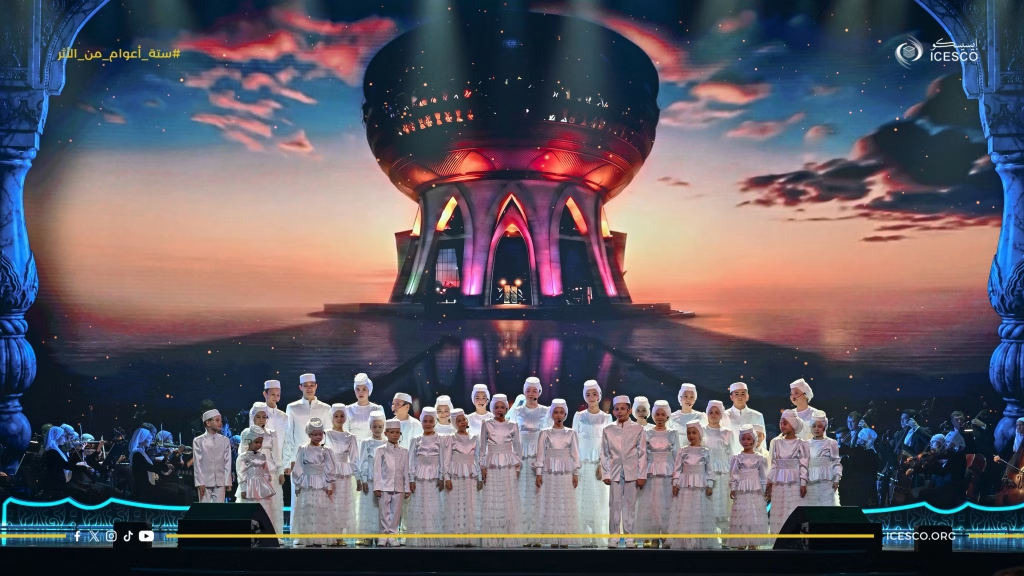
    MoU Signed Between ICESCO and International University of Africa to Provide 100 Scholarships for Students Across the Islamic World

    The Islamic World Educational, Scientific and Cultural Organization (ICESCO) and the International University of Africa signed a Memorandum of Understanding (MoU) on Monday, 6 April 2026, to strengthen cooperation in the academic, scientific and research fields, enhance capacity-building, and implement joint projects in areas of mutual interest, foremost among them the provision of 100 scholarships for students from ICESCO Member States.

    The agreement was signed at ICESCO’s headquarters in Rabat by Dr. Salim M. AlMalik, Director-General of ICESCO, and Dr. Hatem Othman Mohammed Khair, Director of the International University of Africa, in the presence of H.E. Mawadda Omar Haj Al-Toam, Ambassador of the Republic of the Sudan to the Kingdom of Morocco.

    The memorandum of understanding provides for enhancing and exchanging scientific and academic expertise through the organization of training workshops and scientific seminars, participation in conferences and symposia, support for the capacity building of decision-makers and civil society institutions, and the development of specialized training programs for capacity development. It also includes the allocation of scholarships for ICESCO candidates from its Member States.

    Prior to the signing ceremony, Dr. AlMalik and Dr. Khair held a bilateral meeting during which they agreed to establish a joint working committee comprising representatives of both ICESCO and the IUA. The committee will be tasked with preparing implementation plans and programs for the agreed projects, monitoring progress, and evaluating achievements.

    The meeting was attended by Dr. Abdelillah Benarafa, Deputy Director-General; Dr. Sally Mabrouk, Head of the Director-General’s Office and Supervisor of the Strategy and Institutional Excellence Sector; and Ambassador Khaled Fatahalrahman, Head of the Center for Civilizational Dialogue.
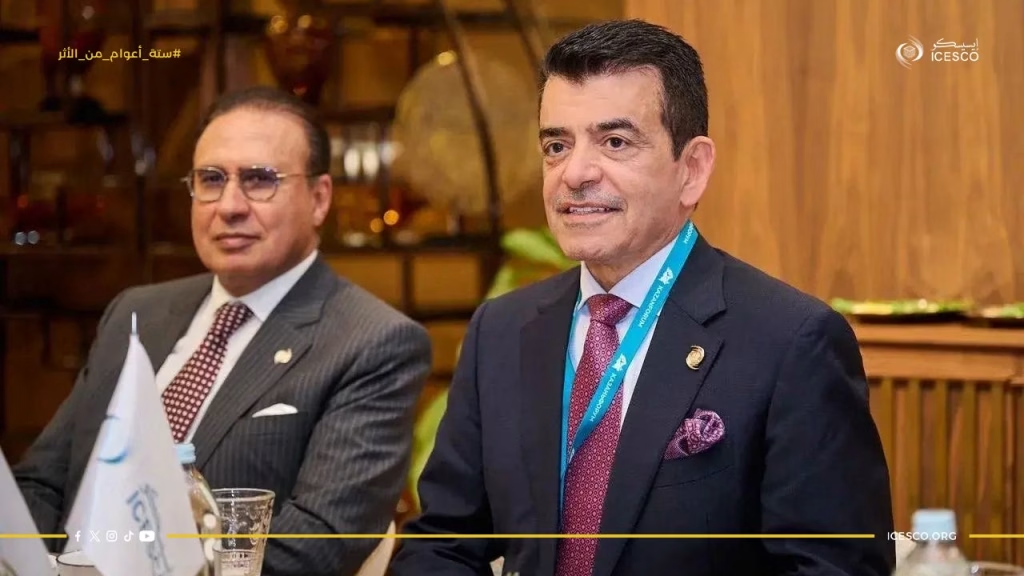
    Dr. AlMalik also accompanied the IUA delegation on a tour of the Organization’s Media and Communication Sector, where detailed briefings were provided on the Sector’s specialized units, including the newly established studio aimed at enhancing the production of digital content supporting ICESCO’s global mission. The delegation also visited the Sultan Qaboos Library housed at ICESCO headquarters, which is scheduled to open on 16 April.