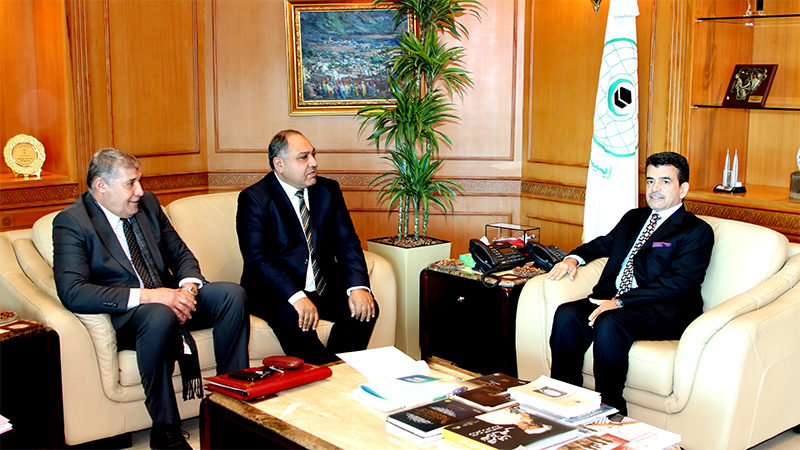
ISESCO Cultural Forum honored Dr. Abbès
Jirari, Dean of Moroccan Literature, and Dr. Ahmed Abbadi, Secretary General of
the Mohammedian League. On this occasion, Dr. Salim AlMalik, ISESCO Director
General, presented each scholar with a certificate of appreciation and
excellence, along with a medal from ISESCO.
The tribute followed the second gathering of the Forum, yesterday evening, which hosted Dr. Abbadi who gave a lecture entitled, “From human rights to humanity rights: Exploring the contextual and knowledge requirements and approaching mechanisms”. The lecture was attended by a large audience of ambassadors and experts, and a host of universities and higher institutes students in Rabat.
Dr. Jirari had been the guest of the gathering
of the first ISESCO Cultural Forum, held on 22 October 2019, wherein he gave a
lecture on the “Future Cultural Challenges in the Islamic World”. Dr. Jirari’s
lecture also brought together a large audience and major media coverage.
The Director General also presented Dr.
Jirari with the first copy of Issue I of the Cultural Forum Gatherings series.
** The global expenditure on armament amounts to US$17 trillion, just to
protect humanity from itself
** Each human being has
individual rights, including the right to privacy which is daily violated on
Internet
The second gathering of ISESCO Cultural Forum, held yesterday at the headquarters of the Islamic Educational, Scientific and Cultural Organization (ISESCO), hosted Dr. Ahmed Abbadi, Secretary General of the Mohammadia League of Scholars, former member of the Moroccan National Council of Human Rights (CNDH), to deliver a lecture on the theme “From Human Rights to Humanity Right: Exploring contextual and knowledge requirements and approaching mechanisms”, on the occasion of Human Rights Day.
The
Forum was largely attended by ambassadors, experts, specialists, media representatives,
and students of universities and higher institutes in Rabat. The gathering
started with an address by Dr. Salim M. AlMalik, ISESCO Director General, in
which he welcomed Dr. Abbadi and the audience, and introduced the theme of the
lecture. Afterwards, Dr. Abbadi delivered his lecture wherein he thanked ISESCO
and its Director General for this invitation and stressed the importance of the
lecture’s theme. He introduced his lecture with five basic principles “a) the human
rights ‘dimension’ is inherent in human beings since their existence and from
such dimension all legislations and procedures have been developed to organize
human life and relations; b) there are many individual rights that should be
framed within an attractive project; c) these rights entail duties; how can people,
for instance, call for the achievement of sustainable development unless they
fulfill their duties toward society and how can they demand peace while they cause
strife among people”.
Moreover,
Dr. Abbadi evoked the ‘fourth generation of human rights’, which takes into account
the current system that considers the right to privacy as a human right. He
also discussed the violations of the right to privacy on Internet, and the issues
of genetic modifications with respect to the ethical dimension. He then went
back on the five principles to present the fourth one which is the current global
crises such as armament and fear crisis stating that the global expenditure on
armament amounts to US$17 trillion, with US$2288 per capita on Earth; i.e.
humanity incurs such massive expenditure to protect itself from itself.
Dr.
Abbadi further explained that human rights did not start with the Magna Carta
back in 1215; it rather began long ago quoting the saying of Umar ibn
al-Khaṭtāb (may Allah be pleased with him): “How can you enslave
people when their mothers bore them as free men?”. Each human
being is free and this notion is established in all religions and might be the
fifth principle.
Afterwards,
Dr. Abbadi stated five phases for tackling individual human rights. “Serious scientific
research is the gate to monitor the development of human rights and provide precise
answers. Such research should adopt a scientific method and have special and
adequate tools for the investigated field, namely human rights”, he stressed.
Dr.
Abbadi also reaffirmed the importance of strengthening, supporting and
assisting human rights institutions so as to full their duties. At the end of
this lecture, Dr. Abbadi received and answered the audience’s questions.
Following this discussion, Dr. AlMalik honored
Dr. Abbès Jirari, Dean of Moroccan Literature, guest of the Forum’s first
gathering, and Dr. Abbadi with a certificate of appreciation and excellence,
and a medal from ISESCO. Dr. AlMalik also
presented Dr. Jirari with the first copy of Issue I of the Cultural Forum
Gatherings series.
**We should explore the human rights processes going beyond the individual dimension to the collective ones and anticipating the future
Dr.
Salim M. AlMalik, Director General of the Islamic Educational, Scientific and
Cultural Organization (ISESCO), stressed that the application of human rights is
an internal affair of every country after due proper institutional
deliberations, advocacy, consultation and management according to societal
consensuses, national dialogue, natural development and national contexts of
each society. “Such action is not based on foreign agendas or strange references
to these societies. This is one of the challenges facing us toward entrenching
the culture of human rights” explained Dr. AlMalik.
This was
part of Dr. AlMalik’s address yesterday at ISESCO Cultural Forum, which hosted
Dr. Ahmed Abbadi, Secretary General of the Mohammadia League of Scholars,
former member of the Moroccan National Council of Human Rights (CNDH), to
deliver a lecture on “From Human Rights to Humanity Right: Exploring contextual
and knowledge requirements and approaching mechanisms”, on the occasion of
Human Rights Day.
At the
outset of his address, Dr. AlMalik welcomed all the participants to ISESCO,
which is a house of expertise for the Islamic world in its areas of competence,
reaffirming ISESCO’s keenness to develop new methods in the management of the
intellectual fields through openness to decision-makers in various knowledge
fields to participate in ISESCO’s activities and listening to their proposals
and opinions on the promotion of culture, education, science and communication
in Member States.
ISESCO
Director General added that “this is a perfect time and context for this
lecture, which deserves due attention as it places the human rights issue at
the core of the concerns of ISESCO, which published many relevant studies in
its working languages, including “the Islamic Declaration on Cultural Rights”
which was approved by the 8th Islamic Conference of Culture
Ministers, held in Al-Madinah Al-Munawarah in 2014.”
Besides,
Dr. AlMalik made it clear that many of ISESCO Member States have taken positive
strides in the process of human rights, which needs further expansion as it
concerns countries and societies, achieves development, and ensures
comprehensive security. “We should take into account the cultural, social,
economic, environmental and technological changes which resulted in many new
problematics with direct impact on Earth and humanity rights. Such problematics
should be solved through the establishment of new human rights processes that
go beyond the individual dimension to the collective ones and move from the
present to the future”, he explained.
ISESCO
Director General stressed that within this
new human rights prospect, going in line with ISESCO’s new vision, which is entrenched
through many important reforms in its plans, programmes, structure and human
resources, the issue of human rights should be among the concerns of
decision-makers, officials and society as it builds the societies in which
security, welfare, justice and equality prevail.
Dr.
AlMalik added that the system of human rights does not only concern
individuals, but it covers also human groups and future generations. “However,
there are historical, cultural and social contexts, knowledge requirements and
implementation mechanisms that should be respected and taken into account. The
human rights issue is not a slogan or a passing celebrated day. It is rather a strong
culture that should be shared and implemented transparently within constructive
dialogue and consultation” he stressed.
At the
close of his address, Dr. AlMalik said “Muslims have given due attention to the
issue of rights at the level of religious assignment, including worship,
dealings, doctrines and discipline, and developed the philosophy of legislation
based on preserving the human dignity. However, they should reconsider them
according to an accurate scientific method and grasp all the developments of
the Islamic thoughts in this field so as to enrich the human rights
achievements in the general human civilizational edifice and achieve the true
meaning of succession as Allah Says: ‘O David, indeed We have made you a
successor upon the earth, so judge between the people in truth’”.
**Dr. AlMalik: The countries of the Islamic world have boundless potentials, which promise a brighter future on the condition that they are well invested.
**ISESCO works on facilitating social integration and developing Islamic solidarity values
The Director General of the Islamic
Educational, Scientific and Cultural Organization (ISESCO), Dr. Salim M.
AlMalik, called for holding an international forum at ISESCO’s headquarters in
Rabat, Kingdom of Morocco, in 2020, with the participation of the regional and
international organizations and civil society bodies concerned with social
development in order to develop a holistic strategy for promoting the
humanitarian and social situation, and helping ISESCO Member States honor their
commitments to achieve Sustainable Development Goals (SDGs) for 2030.
This came in Dr. AlMalik’s address at the
opening session of the First Islamic Ministerial Conference on Social
Development, which kicked off today, in Istanbul, Republic of Turkey, in the
presence of H.E. President Recep Tayyip Erdogan of Turkey, under the theme
“Ensuring Social Equality and Prosperity for All in Member States:
Opportunities and Challenges”.
At the outset of his address, ISESCO
Director General noted that the theme of the conference contains “equality” and
“prosperity”, which reflect two key goals of the SDGs 2030. “This raises the
following questions: What is the degree of progress our countries have made
since 2015 to fulfill their commitments regarding the Seventeen Sustainable
Development Goals (SDGs), after nearly a third of the period ahead of 2030?
What urgent strategies and measures should we take to speed up the pace of
progress?”, Dr. AlMalik said.
He also wondered how should Muslim
countries make up for lagging behind developed countries at a time when the
countries of the Islamic world allocate a mere 0.4% of their gross domestic
product for scientific research and development in a world that has witnessed
the growth of invention patents in cutting-edge technologies and artificial
intelligence over the last twenty five years by 1000%?.
He added that world states, including the
Muslim ones, committed themselves to achieve the fourth SDG on education. “Yet,
more than 64 million children are out of school in these countries for social
and economic reasons, and illiteracy rate stands at 40% of the population, of
which 65% are girls and women. Underage marriage in our Islamic world is also a
sad phenomenon, a painful reality and a key factor of the girls’ social
isolation and for their prevention from pursuing their education”, the Director
General further explained.
Moreover, Dr. AlMalik stated that the nations
of the world also committed themselves to achieve the first and second SDGs on
the elimination of poverty and hunger. Yet again, he maintained, utter poverty
is still prevalent in the Islamic world with 16% of the population living on
less than two dollars a day; and there are no near-term prospects for a shrink
of hunger levels in many regions of Africa and West Asia where malnutrition has
reached 12% of the population.
Likewise, ISESCO director general warned
that in a world where the intensity of conflicts, natural disasters,
immigration waves and displacement is not abating, and in view of the report
released by the United Nations Office for the Coordination of Humanitarian
Affairs (UNOCHA), on 4 December 2019, nearly 168 million people all over the
world will require humanitarian assistance and protection in 2020, the highest
figure to be recorded in decades.
Dr. AlMalik also stated that faced with
these conditions and circumstances, the countries of the Islamic world have
boundless potentials, which promise a brighter future for its children and for
the coming generations on the condition that they are well invested. “One of
these potentials is the young forces and the high rate of children and youth in
its demographic fabric, the hidden talents that require to be discovered and
encouraged, and the high technical and scientific competencies either inside
our countries or in the diasporas which can strongly contribute to the
localization of advanced technology and scientific research in our countries”,
he maintained.
Furthermore, the Director General underscored
that the current situation, whose features and aspects are unfolding through
facts and figures, not only requires Muslim countries to pay further attention and make stronger commitment,
but also motivates them to gear their action towards finding effective and
viable solutions to the humanitarian and social issues. “Therefore, we should
all assume our responsibilities in achieving the social development for our
peoples based on a holistic human rights approach that considers poverty,
illiteracy, educational deprivation, all forms of social exclusion,
malnutrition, water shortage, poor sanitation and environmental aggressions as
flagrant violations of human rights”, Dr. AlMalik stressed.
Against this backdrop, the
Director General stated that ISESCO has developed a new vision through which it
seeks to become a beacon of global outreach to anticipate the issues of human
development and focus on the elimination of poverty, counter extremism and hate
speech; a vision that is centered on the human being; one that respects the
environment, preserves the dignity of all and treats all people on equal
footing.
He also maintained that under
this vision, ISESCO renews its commitment to better support its Member States
through developing a special system with indicators for measuring social
development in the countries of the Islamic world; analyzing the disparities
between them; monitoring the social transformations; preparing a comprehensive
strategy for combatting poverty to contribute to sustainable social development
and to promote peace for humanity as a whole; and supporting education that
values diversity, arts and sports in order to build inclusive societies for all.
“While we praise and
appreciate the efforts exerted by our Member States in the field of social
development, we reaffirm ISESCO’s commitment to facilitate and promote, through
a Social Solidarity Economy (SSE) approach, the socio-economic integration of
the vulnerable grassroots communities and develop the Islamic values of
solidarity and entrepreneurship”, the Director General announced.
Dr. AlMalik also stressed that the Conference
resolutions should focus on meeting the
actual needs of Muslim communities; building bridges of cooperation with
leading international organizations operating in development and humanitarian
action to create synergies and complementarity in our actions; adopting an
integrated approach for fighting poverty, extremism and terrorism; and
fostering further harmony and efficiency to ensure a steady improvement of
people’s life standards and an equitable participation to achieve prosperity
for all.
Dr.
Salim M. AlMalik, Director General of the Islamic Educational, Scientific and
Cultural Organization (ISESCO), today in Istanbul, Turkey, met Dr. Jamila EL
Moussali, Moroccan Minister of Solidarity, Social Development, Equality and
Family, before their participation tomorrow in the First Islamic Ministerial
Conference on Social Development.
During
this meeting, the two parties explored the promotion of cooperation between
ISESCO and the Kingdom of Morocco as part of ISESCO’s new vision, which adopts
the programmes and activities with concrete and direct positive output. Dr.
AlMalik and Dr. EL Moussali also tackled ISESCO’s participation in the
Programme of Integrated Territorial Bodies for Children Protection, being implemented
by the Ministry of Solidarity, Social Development, Equality and Family with the
contribution of many Moroccan governmental sectors and some civil society
organizations operating in the field of children protection.
Besides,
the meeting explored the rehabilitation of elderly peoples centres. Morocco includes
62 centres, of which 32 have been rehabilitated and 30 still need rehabilitation.
The two parties agreed to involve ISESCO in the restoration and rehabilitation
of these centres.
They
also agreed on the programme of the Medical, Social and Educational Caravan, to
be launched next January in cooperation between ISESCO and the Moroccan
Ministries of Solidarity, Social Development, Equality and Family; Health; and
Education.
In
addition, Dr. AlMalik and Dr. EL Moussali agreed to establish a psychosocial
therapy centre for the victims of oppression, particularly for women and
children, in 2020. The meeting was attended from ISESCO by Dr. Rahmata Almamy
Mbaye, Director of Human and Social Sciences.
The Director General of the Islamic Educational, Scientific and Cultural Organization (ISESCO), Dr. Salim M. AlMalik, met with Ms. Ndeye Saly Diop Dieng, Minister of Women, Family and Gender of Senegal, and together they discussed ways to promote cooperation between ISESCO and the Republic of Senegal in the Organization’s areas of competence.
In a meeting
held in Istanbul, Turkey, hours prior to the First Ministerial Conference on
Social Development, the parties agreed to scale up cooperation through
practical steps, inter alia, the launch of the medical, social and scientific
caravan next year in Senegal in service of Senegalese citizens with Senegal
contributing to the Caravan’s needs.
Moreover,
Dr. AlMalik and Ms. Dieng agreed to set up a center for psychosocial treatment
of women and children victims of persecution in 2020, in cooperation between
ISESCO and the Senegalese Government, represented by the Ministry of Women,
Family and Gender.
This
agreement is part of ISESCO’s new vision and strategy of its future action that
advocates the empowerment of women, youth and children and promotes the access
of all to education. It focuses on sustainable development issues, poverty eradication,
the fight against extremism and hate speech and support of civil society.
The meeting
was attended by Ms. Ramata Almamy Mbaye, Director of Human and Social Sciences.
The Islamic Educational, Scientific and
Cultural Organization (ISESCO) took part in the International Charity Bazar,
held on Saturday, at Mohamed V National Theater in Rabat, under the high
patronage of His Majesty King Mohamed VI of Morocco, and the effective
presidency of Their Royal Highnesses the Princesses of Morocco. The Bazar was
opened by H.R.H. Princess Lalla Meryem.
ISESCO set a special stand at the Bazar,
which was overseen by Dr. Yousra AlJazairy, spouse of H.E. ISESCO Director
General, with the participation of Ms. Hanane Ghazi, Ms. Zineb Iraqi, and Ms.
Majda Souaf.
For his part, Dr. Salim M. AlMalik, ISESCO
Director General, visited the Bazar and welcomed the visitors of ISESCO stand.
He also visited several Member States’ stands and held friendly conversations
with the managers of these States’ stands, hailing the organization and noble
charitable cause of the Bazar.
ISESCO’s stand contained a number of
ISESCO’s publications, and items related to child education through play, which
was well-received and appreciated by the Bazar’s visitors.
In her address at the opening of the
Bazar, H.R.H. Princess Lalla Meryem commended the projects carried out by the Diplomatic Circle in the cultural and social fields,
and the associations it supports.
It is worth noting that the International
Bazar in Rabat is an annual event that includes an open buffet of traditional
food from participating countries, in addition to displays of the respective
local and artisanal products of a large number of countries from different
continents. The proceeds of the Bazar are donated to charitable associations
targeting women and supporting education.
Dr.
Salim M. AlMalik, Director General of the Islamic Educational, Scientific and
Cultural Organization (ISESCO), explored with Mr. Said Amzazi, Moroccan
Minister of National Education, Vocational Training, Higher Education and
Scientific Research, ways to promote cooperation between ISESCO and Morocco in
the fields of common interest, particularly ways to benefit Member States,
particularly African countries, from the Moroccan experience in the ‘Education
Programme II’, organized under the partnership between the Kingdom of Morocco
and the European Union.
This
meeting was part of Dr. AlMalik’s participation in the closing ceremony of
‘Education Programme II’, organized by the Ministry of National Education,
Vocational Training, Higher Education and Scientific Research in
partnership with the European Union Delegation in the Kingdom of Morocco, yesterday
at ‘Palais des Congrès’ in Sale. The ceremony was presided over by Mr. Amzazi
and Ms. Claudia Wiedey, Ambassador and Head of the European Union Delegation in
Morocco.
The
meeting was attended by Mr. Youssef Belkacemi, Secretary General of the
Ministry; and from ISESCO by Dr. Kais Hammami, Director of the Centre of
Strategic Anticipation, and Mr. Aziz Elhajir, Expert at the Directorate of
Education.
It is
worth mentioning that ‘Education Programme II’ falls within the framework of the
partnership between the Kingdom of Morocco and the European Union aiming to
support efforts for reforming the system of education and training, boost and
provide the universal compulsory education, promote the principle of gender
equality in access to education, and provide students with easy access to the
vocational training, university and job market.
The Director General of the Islamic Educational, Scientific and Cultural Organization (ISESCO), Dr. Salim M. AlMalik, today at the Organization’s headquarters in Rabat, received Dr. Abdulmajeed bin Abdullah Albanyan, President of Naïf Arab University for Security Sciences (NAUSS) in the Kingdom of Saudi Arabia, and the accompanying delegation, and together they explored cooperation prospects between ISESCO and NAUSS in various fields.
During the meeting, the two parties agreed to conduct joint research and studies, hold symposia and conferences at ISESCO and NAUSS and many Member States in the fields of the fight against extremist thought and zealotry; strategic anticipation in social fields; and cyber-security to promote global peace and security and develop forecasting programmes for natural disasters and their risk reduction.
The meeting was held as part of ISESCO’s new vision and future action programme that promote openness to civil society organizations, research and studies centers and universities, thereby according utmost attention to youth empowerment and capacity-building through effective programmes with measureable direct impact.
A permanent and supportive member of the Federation of the Universities of the Islamic World (FUIW), NAUSS hosts the Center of Scientific Research Ethics at its Riyadh-based headquarters. A number of symposia and workshops have been co-held by ISESCO, NAUSS and the FUIW.
Dr. Salim M. AlMalik, Director General of the Islamic Educational, Scientific and Cultural Organization (ISESCO), explored with Mr. Hassan Abyaba, Moroccan Minister of Culture, Youth, Sports and Spokesperson of the Moroccan Government, ways to develop cooperation between ISESCO and the Kingdom of Morocco.
This was part of the meeting of Dr. AlMalik and ISESCO delegation with Mr. Abyaba at the headquarters of the Communication Department. The two parties agreed to inscribe a larger number of Moroccan heritage sites on the Islamic World Heritage List, which ISESCO has taken great steps to enrich as part of the Organization’s new vision to build a capacity-building system so as to safeguard and rehabilitate the cultural and civilizational heritage to contribute more strongly to the economic and social development of ISESCO Member States.
ISESCO and the Moroccan Ministry have agreed to cooperate in restoring the heritage sites in ISESCO Member States, benefit from Moroccan expertise in the field, examine the nomination of Rabat to be the Capital of Islamic Culture, and provide ISESCO with a set of masterpieces, which reflect the aesthetics of the Moroccan handicrafts, to be exhibited at ISESCO headquarters.
Moreover, Dr. AlMalik invited Mr. Abyaba to attend the 2nd gathering of ISESCO Cultural Forum, to be held on 10 December 2019, which hosts Dr. Ahmed Abbadi, Secretary General of Mohammedan League of Scholars, Member of the National Human Rights Council of the Kingdom of Morocco (CNDH), who will give a general lecture, under the theme “From human rights to humanity rights: Exploring contextual and knowledge requirements and approaching mechanisms”.
As for the human and social issues, ISESCO Director General and the Moroccan Minister explored the involvement of Moroccan young people in the programmes of capacity-building and combating domestic violence, particularly against children, and other programmes organized by ISESCO.
The meeting also tackled ISESCO’s Strategic Anticipation Centre, the importance of such discipline nowadays, its relation with creative industries, and anticipating professions of tomorrow in the field of culture.
The meeting was attended from the Ministry by Mr. Mustapha Eltimi, Secretary General of the Sector of Communication, and Mr. Abdelilah Eltahani, Director of Communication and Public Relations; and from ISESCO by Ms. Rahmata Almamy Mbaye, Director of Human and Social Sciences, Dr. Kais Hammami, Director of the Strategic Anticipation Centre, and Dr. Abdelilah Benarafa, Cultural Advisor to the Director General.