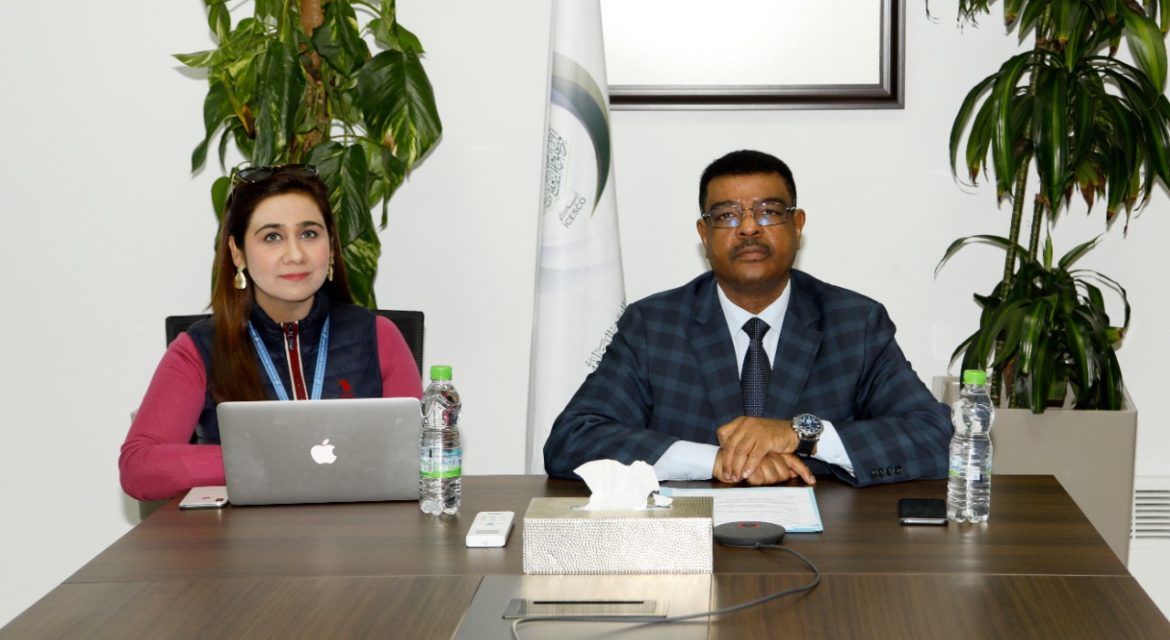
The Islamic
World Educational, Scientific, and Cultural Organization (ICESCO) held yesterday
a videoconference with the International Islamic University Malaysia (IIUM) to examine
future cooperation between the Organization and IIUM in sciences and scientific
research.
Dr. Raheel
Qamar, Head of the Science and Technology Sector, and several other Sector
officials represented ICESCO, while Dr. Ratnawati Mohd Asraf, Deputy
Rector and Dean of the Research Management Centre at the University,
represented IIUM.
During the
meeting, Dr. Raheel Qamar reviewed the vision and strategy of ICESCO’s Science
and Technology Sector, and highlighted its future activities and programs,
noting that the Organization adopts an approach based on openness to and
cooperation and partnerships with universities, given their pioneering role in
developing societies.
Dr. Asraf reiterated
IIUM’s interest in cooperating with ICESCO, especially in organizing workshops
and training courses in the scientific and research fields.
The two parties
agreed to organize an international training workshop on writing scientific
articles and developing patents, to be held over two days during December, in
addition to other capacity-building activities.
The two
parties also agreed to hold another meeting between their respective representatives
and officials to explore mechanisms for joint cooperation and identify the roles
of each party.
Dr. Salim M. AlMalik, Director-General (DG)
of the Islamic World Educational, Scientific, and Cultural Organization
(ICESCO), expressed his condolences on the passing of Sadiq al-Mahdi, Former
Prime Minister of Sudan, may Allah rest his soul, at the headquarters of the
Embassy of Sudan in Rabat.
Dr. AlMalik, on behalf of ICESCO’s staff
members, expressed his sincere condolences to the people and government of
Sudan on the death of the Late Sadiq al-Mahdi, on Thursday, November 26, 2020, while
citing al-Mahdi’s great and outstanding roles to serve his country.
In his statement on the Embassy’s book of
condolences, Dr. AlMalik stressed that the Late Sadiq al-Mahdi was a great
figure who earned respect and recognition through his sincere work and
enlightened thinking, as well as his sustained efforts to develop his country
and the Islamic world.
Dr. Salim M. AlMalik, Director-General (DG)
of the Islamic World Educational, Scientific, and Cultural Organization
(ICESCO), received yesterday Ms. Sylvia Lopez-Ekra, UN Resident Coordinator in
Morocco. The two parties explored the cooperation prospects between ICESCO and
the United Nations (UN) in the areas of common interest.
At the ICESCO’s headquarters in Rabat, Dr.
AlMalik reviewed the main features of the Organization’s vision and strategy.
ICESCO adopts an open-door policy towards promoting cooperation and
partnerships with international organizations to benefit the Member States. The Organization further supports achieving
sustainable development goals and strengthening the spirit of peaceful
coexistence based on civilizational and cultural dialogue and diversity.
The ICESCO DG highlighted the main
programs, initiatives, and activities that the Organization launched and
implemented to help its Member States cope with the negative repercussions of
the COVID-19 pandemic.
“ICESCO held several important international
videoconferences and virtual forums with high-level participation. ICESCO also established
multiple specialized centers in the fields of strategic foresight, Artificial
Intelligence, Arabic language for non-Arabic speakers, and heritage to
anticipate the future changes ahead based on scientific foundations and
in-depth studies,” he added.
The meeting touched upon the areas of
cooperation between ICESCO and the UN, represented by its Office in Morocco.
The areas included the quality of education, support for innovation, youth
empowerment, and women’s integration in the economy. The focus was particularly
on the new economies such as the digital and knowledge-based economy, as well
as the development of an innovative working model to be adopted by the end of
2021 before the start of the next strategic cycle.
Dr. AlMalik stressed that these areas fully
reflect multiple axes of ICESCO’s Action Plan, which promotes future young
leaders training by hosting an elite group of young academics at its
headquarters to strengthen their capacities and gain diverse experiences. ICESCO
also prepares a wide range of programs and activities during 2021, proclaimed
as the Year of Women, in appreciation of female efforts during this pandemic and
promotion of women’s status.
The UN Resident Coordinator in Morocco commended
ICESCO’s outstanding work in the Organization’s fields of competence. She also underscored
her keenness to develop cooperation between the two parties.
The Director-General
(DG) of the Islamic World Educational, Scientific, and Cultural Organization
(ICESCO), Dr. Salim M. AlMalik, met with several ministers of foreign affairs
and heads of delegations of Islamic world countries. The meetings were on the
sidelines of their participation at the 47th session of the OIC
Foreign Council on 27 November 2020, as a face-to-face two-day event under the
theme “United Against Terrorism for Peace and Development” in Niamey, Niger.
Dr. AlMalik
met the foreign ministers of Saudi Arabia, Libya, Pakistan, Azerbaijan,
Senegal, Benin, the Gambia, Mauritania, Tunisia, the Sudan, and Côte d’Ivoire.
He also met the representatives of Iraq, Djibouti, Indonesia, and Yemen, along
with Mr. Hussein Ibrahim Taha from Chad, the OIC Secretary-General elect.
The DG
explored cooperation opportunities between ICESCO and Islamic world countries
in the areas of education, science, and culture under the Organization’s new
vision and working strategy based on enhanced communication with the Member
States. Both the vision and the strategy aim to identify the priorities and
needs of Member States and design major programs and projects. ICESCO will
co-implement the programs along with the competent authorities in each Member
State.
ICESCO DG
reviewed with the foreign ministers and heads of delegation ICESCO’s main
initiatives, projects, and programs to support Member States in their efforts
to face the adverse repercussions of the COVID-19 pandemic, namely in
education, science, and culture. He also noted that in the last year the
Organization went through significant development and renewal and is now is one
of the leading organizations operating in the fields of education, science, and
culture.
The
ministers and heads of delegation lauded ICESCO’s excellent action and
reiterated their countries’ commitment to sustaining cooperation with ICESCO in
its areas of action.
Dr. Salim M. AlMalik, Director-General (DG) of the
Islamic World Educational, Scientific, and
Cultural Organization (ICESCO), reaffirmed that overcoming the COVID-19
pandemic requires intensifying efforts, complementing roles, and exchanging expertise.
The DG also called on countries
of the Islamic World to form a high-level team of specialized experts
and distinguished researchers to address the current repercussions. He noted that ICESCO Center for Strategic Foresight,
as well as competent sectors at the Organization, are willing to contribute to
the preparation of the systematic approach of the mission and performance of the team.
The statement was part of Dr. AlMalik’s address
at the 47th session of the Council of Foreign Ministers of the
Organization of Islamic Cooperation (OIC), which kicked off on Friday, November 27, 2020, in Niamey, Niger.
The session was under the theme: “United against Terrorism for Peace and
Development.” The Council concluded its proceedings last Saturday.
ICESCO DG
thanked the government of Niger for the warm reception, and the OIC General
Secretariat, which its Secretary-General represents, for the invitation to attend the session. The event was
the first of its kind since the start of COVID-19 pandemic.
“This reflects the participants’ responsibilities
to find the necessary solutions and measures to address the negative
repercussions of this pandemic,” he added.
Dr. AlMalik explained that ICESCO, by virtue of its
competencies and in light of its tasks, has taken the
pandemic as an opportunity to consolidate its position on the international scene.
ICESCO launched a set of strategic initiatives to
support the efforts of Member States in mitigating
the effects of the pandemic. These initiatives included:
An
international award for discovering an efficient treatment or protective
vaccine against the COVID-19 pandemic, with USD 200,000
in prize money.
An integrated virtual learning program to
link students with their teachers and schools,
including a package of electronic materials, equipment,
and software for the benefit of 30 of the neediest Member States.
ICESCO
Digital Home initiative, which contains rich materials, knowledge resources,
scientific references, educational curricula,
and educational media.
Technical and logistical support to several Member States that the
pandemic affected.
The
Societies We Want Initiative, which is part of ICESCO’s
knowledge initiatives with a set of strategic studies on the future of
the Islamic world, the future of Africa, and the
ethics of Artificial Intelligence.
ICESCO also
held videoconferences of education ministers and
culture ministers, in addition to dozens of
forums and international conferences, meetings,
and lectures on educational, scientific, and
cultural issues related to the impact of the pandemic.
In a bid to
ensure the cohesion of all these efforts, ICESCO established the Comprehensive
Humanitarian Coalition to mobilize competencies
and unify the efforts aiming at confronting the pandemic.
ICESCO DG called
on the participating countries to further support the Comprehensive
Humanitarian Coalition to achieve its objectives in the upcoming period.
“The Coalition’s operational program
includes a set of field projects and specialized activities. Several Member
States and regional and international organizations have already joined it. Besides,
the leaders of many Member States commended this Coalition,” he concluded.
As part of the “Comprehensive Humanitarian Coalition” and the “Societies We Want” initiatives, the Islamic World Educational, Scientific, and Cultural Organization (ICESCO) provided USD 100,000 in aid to Niger to support NGOs and several flood-hit local communities to rehabilitate the infrastructure.
During a special ceremony organized on Friday, November 27, 2020, in Niamey, Dr. Salim M. Al-Malik, ICESCO Director-General (DG), and Dr. Idi Illiassou Mainassara, Minister of Public Health of Niger, signed the agreement detailing the projects and programs that the grant will fund. The implementation will take place in cooperation with the Organization and the concerned authorities in Niger.
Mrs. Brigi Assalo, the wife of the Prime Minister of Niger, attended the signing on behalf of the First Lady of Niger, Dr. Lalla Issoufou Maleika, who sponsors several institutions and associations working in the humanitarian and social fields and the health sector in the country.
The agreement sustains ICESCO’s efforts to support its Member States in countering the negative effects of crises through a set of initiatives, projects, and programs that the Organization has launched and implemented since the beginning of the Covid-19 pandemic.
The Islamic World Educational, Scientific, and Cultural Organization (ICESCO) took part yesterday, in the conference on “The Sectarian World of Central Asia: Status, Risks and Methods of Resolution.” The Nursultan Nazarbayev Center for Development of Interfaith and Intercivilization Dialogue held the videoconference in Kazakhstan. Several religious leaders and representatives of international organizations attended the conference to discuss pertinent issues on the prospects of inter-state relations in the sectarian field.
Ambassador Khalid Fathalrahman, Director of the Department of Dialogue and Cultural Diversity, and Dr. Sidra Tariq Jamil, communication expert at the same Department, represented ICESCO. Ambassador Fathalrahman stressed that the tolerance that prevails in the majority of countries in the region is the result of long years of cultural coexistence. These countries were part of the former Soviet Union, and are all characterized by similar limited levels of development, he explained. The Ambassador stated that the continuity of coexistence largely depends on governments’ adoption of policies that take into account the ethnic and religious and multicultural diversity of the region.
During the conference, the Nursultan Nazarbayev Center for Development of Interfaith and Intercivilization Dialogue presented the various initiatives that Kazakhstan undertook to promote peace and harmony among societies and peoples of the world.
The Director-General (DG) of the Islamic
World Educational, Scientific, and Cultural Organization (ICESCO), Dr. Salim M.
AlMalik, met with H.E. Muhammadu Issoufou, President of Niger. The meeting
occurred on the sidelines of the two-day 47th session of the Council
of Foreign Ministers of the Organization of Islamic Cooperation (OIC) that
kicked off face-to-face yesterday in Niamey under the theme: “United Against
Terrorism for Peace and Development.”
During the meeting, ICESCO
DG congratulated the President of Niger on the successful hosting of the
session of the OIC Council of Foreign Ministers and expressed his thanks to
Niger for the warm reception and good organization.
President Issoufou praised
the distinguished work ICESCO undertook in support of its Member States. The
president appreciated the Organization’s programs and projects in Niger, in
cooperation with the competent authorities, especially with regards to
supporting efforts to counter COVID-19.
President Issoufou had
received Dr. AlMalik at the presidential palace in Niamey during the DG’s
official visit to Niger last January. During the visit, the two sides agreed to
develop cooperation between ICESCO and Niger in the Organization’s fields of
action.
Dr. Salim M. AlMalik, Director-General (DG) of the Islamic World Educational, Scientific, and Cultural Organization (ICESCO), explored on Friday in Niamey, the areas of cooperation between ICESCO and Niger with Dr. Daouda Mamadou Marthé, Nigerien Minister of Primary Education, Literacy, Promotion of National Languages and Civic Education, President of the Nigerien National Commission.
During the meeting, the two parties examined the implementation phases of ICESCO’s cooperation projects and programs in Niger, in the fields of education, science, and culture. The Minister lauded ICESCO’s assistance to Niger during the COVID-19 pandemic. He also commended the Organization’s outstanding work in the educational, humanitarian, and social fields while stressing Niger’s keenness to sustain constructive cooperation and partnership with ICESCO.
The current visit of Dr. AlMalik to Niger is part of his participation in the 47th session of the Council of Foreign Ministers of the Organization of Islamic Cooperation (OIC), being held on 27-28 November 2020, in Niamey, under the theme: “United against Terrorism for Peace and Development.”
The Islamic World Educational, Scientific, and Cultural Organization (ICESCO) and the National Commission for Education, Science, and Culture of Niger launched the “Project on countering the effects of the COVID-19 pandemic by supporting innovation and the development of entrepreneurship among women and youth” in Niger. The project is part of the support that Alwaleed Philanthropies provided to implement a joint initiative with ICESCO to help 10 African countries confront the negative repercussions of the COVID-19 pandemic.
The ceremony, which took place yesterday, November 27, 2020, in Niamey, was organized under the patronage of His Excellency the President of Niger, Mohamedou Issoufou. The event saw the participation of Mrs. Brigi Assalo, wife of the Prime Minister of Niger, on behalf of Dr. Lalla Issoufou Maleika, the First Lady of Niger; Dr. Salim M. Al-Malik, Director-General (DG) of ICESCO; and Minister of Primary Education, Literacy, Promotion of National Languages and Civic Education, President of the Nigerien National Commission, Dr. Daouda Mamadou Marthé, and several Niger government ministers, representatives of the United Nations, civil society organizations, and NGOs.
During her address at the ceremony, which the wife of the Prime Minister of Niger delivered on her behalf, Dr. Maleika praised ICESCO’s new vision, which prioritizes Africa. She also praised the initiatives the Organization launched and implemented to support the efforts of Member States in addressing the COVID-19 pandemic. The initiatives included the “comprehensive humanitarian alliance” that multiple countries, institutions, international bodies, and donors joined and supported. The goal was to strengthen humanitarian and social aid and implement tangible projects and programs in several countries that the pandemic affected.
Dr. AlMalik reaffirmed, during his address, that ICESCO will continue to work with African countries to advance education, science, and culture. The effort is part of ICESCO’s reengineered vision to become a reference point for civilizational outreach, leading the Organization’s Member States towards a better era based on Artificial Intelligence and technologies.
The DG expressed his gratitude to ICESCO’s permanent partner, Alwaleed Philanthropies, chaired by HRH Prince Alwaleed bin Talal AlSaud, for the Foundation’s generous support to the ICESCO’s humanitarian and social initiatives to help 10 African countries, including Niger.
At the end of the ceremony, Dr. AlMalik and Dr. Marthé signed a memorandum of understanding (MoU) on the implementation phases of the project. The goal is to develop a sense of innovation and entrepreneurship among women and youth in Niger and support the private sector, entrepreneurs, and small enterprises.
For four decades, Alwaleed Philanthropies has supported and spent more than 4 billion dollars on social welfare and initiated more than 1000 projects in over +189 countries, managed by 10 Saudi female members, reaching more than 1 billion beneficiaries around the world, regardless of gender, race, or religion. Alwaleed Philanthropies collaborates with a range of philanthropic, governmental, and educational organizations to combat poverty, empower women and youth, develop communities, provide disaster relief, and create cultural understanding through education. It seeks to build bridges for a more compassionate, tolerant, and accepting world.