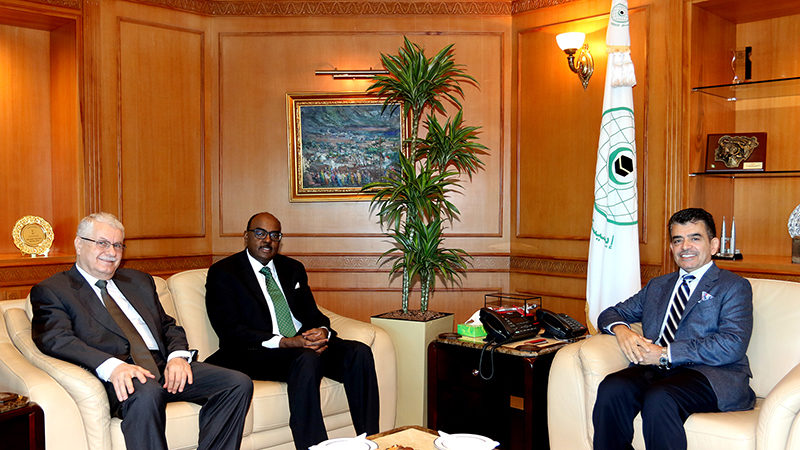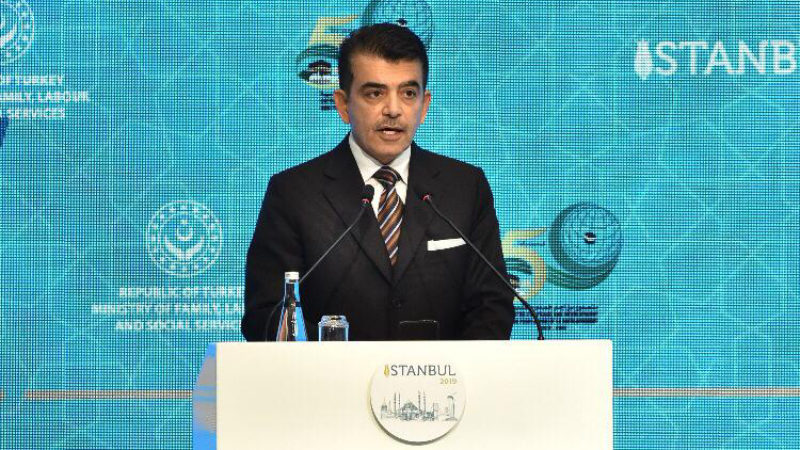
Dr. Salim M. AlMalik, Director General of the Islamic Educational, Scientific and Cultural Organization (ISESCO), explored with Mr. Azzedine Saeed Al-Asbahi, Ambassador of the Republic of Yemen to the Kingdom of Morocco, ways to develop cooperation between ISESCO and Yemen in the coming period, take practical steps towards overcoming the difficulties which face the educational process, and preserve heritage and natural reserves in Yemen.
During this meeting, held today at ISESCO headquarters, the two parties explored the support that ISESCO may grant to the sector of education in Yemen to digitalize the Yemeni educational curricula as part of ISESCO’s new vision aiming to empower youth, women and children to exercise their educational, scientific and cultural rights. Besides, ISESCO Director General reaffirmed the Organization’s willingness to host and train a number of Yemeni young people on the latest techniques in the fields of education, science, culture and communication.
The meeting also exchanged views on the threats facing the Yemeni heritage and archeological sites. In this regard, Dr. AlMalik stressed the need to inscribe the Yemeni heritage sites on the Islamic World Heritage List and restore the damaged sites. He also invited the Yemeni Ambassador to attend the Extraordinary Meeting of the Islamic World Heritage Committee, to be held on 2-3 December 2019 at ISESCO headquarters in Rabat, to present this issue to the participants in the meeting.
Furthermore, Dr. AlMalik stressed the need for concrete action to solve the problems facing natural reserves in Yemen through visits of experts to assess the current situation, develop a strategy therefor and put practical solutions to preserve these reserves.
The meeting was attended by Dr. Ahmed Said Bah, Director of External Relations and Cooperation,p Dr. Kais Hammami, Director of the Strategic Anticipation Centre, and Dr. Abdelilah Benarafa, Cultural Advisor to the Director General.
Dr. Salim M.
AlMalik, Director General of the Islamic Educational, Scientific and Cultural
Organization (ISESCO) discussed with Mr. Dah Ould Sidi Ould Amar Taleb,
Minister of Islamic Affairs and Traditional Education of Mauritania, the
promotion of cooperation between the two parties in education, science and
culture.
During this
meeting held at ISESCO headquarters, Dr. AlMalik and Mr. Taleb agreed to boost
support for ISESCO Regional Educational Center for the Promotion of Traditional
Education in Nouakchott, cooperate in establishing the Institute of Training
Imams and Preachers, conduct studies on the development of ‘Mahdras’
(traditional Quranic schools) and publicize their objectives, working
mechanisms and impact at the educational, scientific and cultural levels.
For the record,
ISESCO Educational Center in Nouakchott was established under an agreement
signed on 22 October 2014 between ISESCO and the Mauritanian Ministry of
Islamic Affairs and Traditional Education. The Centre started operating in July
2017 with the first 9 month-long educational training session for traditional
education teachers in Mauritania.
The Centre’s
continuous training programmes aim to provide trainees with the necessary
educational and methodological skills to plan, schedule, implement and assess
the educational activities, and strengthen ties between trainees and the
Islamic values and Arabic culture, and ensure openness to contemporary culture
through the adopted educational curriculum.
Dr. Salim M. AlMalik, Director General of the Islamic Educational, Scientific and Cultural Organization (ISESCO), explored with His Highness Prince Faisal Bin Farhan, Saudi Minister of Foreign Affairs, the cooperation ties between the Organization and the Kingdom of Saudi Arabia. Dr. AlMalik also reviewed ISESCO’s activities and future programmes within the framework of the new strategic vision, which makes of ISESCO a source of civilizational influence in the Islamic world as well as the rest of the world.
This was part of today meeting of the Saudi Minister of Foreign Affairs with ISESCO Director General, who congratulated the Minister on the trust of the Custodian of the Two Holy Mosques, King Salman Bin Abdulaziz, and his new position.
The meeting further highlighted the great interest and considerable support of the Kingdom of Saudi Arabia for the efforts of ISESCO in the fields of education, science and culture.
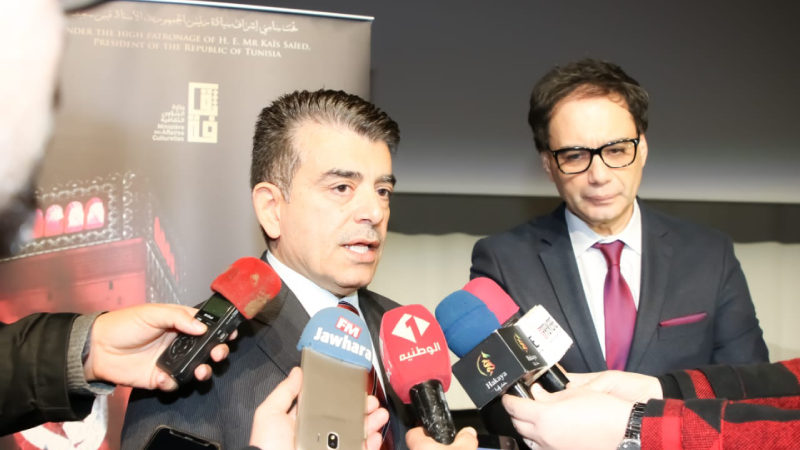
Dr. Salim M. AlMalik, Director General of the Islamic Educational, Scientific and Cultural Organization (ISESCO), stated that the Organization has entered into a new phase of rebuilding based on an innovative vision, a developed methodology and modern foundations in its pursuit to achieve a genuine transformation to secure its proper international position and keep up with the rapid changes and modern technologies.
His statement was part of the press conference held today at ISESCO headquarters. Dr. AlMalik started this meeting with media professionals by saying that “ISESCO was founded to become the Islamic world’s version of UNESCO. Today, we seek to become an international organization rather than a local or regional one. Besides, this aspiration is legitimate as it hinges upon a new vision which constitutes the basis of a strategy having future dimensions.”
Moreover, ISESCO Director General stressed that the Islamic world deserves having a high-standing organization, with wide impact on Muslim communities inside and outside the Islamic world, which expresses the Muslim world’s enlightened vision on contemporary issues relevant to ISESOC’s areas of competence.
Dr. AlMalik further highlighted that modernizing ISESCO both in form and content is the major objective which includes the strategic objectives of the Organization. He also explained that ISESCO’s new vision is based on three foundations: a) innovation in planning and achievement, and modernization of performance while rationalizing costs through a developed financial management; b) openness to the prospects of this era so as to be enlightened with modern humanist ideas and international expertise in education, science, innovation, culture, communication and creativity by establishing “ISESCO International Consultative Body”; c) transformation of ISESCO from an organization with limited resources into an organization which produces resources through the establishment of the Waqf Fund on modern bases to ensure its security and continuity in times of crises likely to drain its resources.
ISESCO Director General also said “Our vision aims to turn ISESCO into an international beacon in the fields of civilizational building and knowledge progress, and make of its conferences, meetings and workshops occasions to present new initiatives and useful innovative ideas.”
Besides, Dr. AlMalik stated “we are working to make ISESCO an organization of competencies and a leadership and creativity center, which coordinates the efforts seeking to develop policies and educational systems in Member States, and improve the performance and outputs of these systems.”
He further added that ISESCO should have a purposeful and innovative information mission, an effective communication strategy to defend and promote the status of Arabic language at the Islamic and international levels through the programmes of teaching Arabic language to non-Arabic speakers, support the programmes of writing the languages of Muslim peoples in Arabic script, and become open to the Muslim peoples regardless of the geographical borders.
Dr. AlMalik also underscored that the mission of ISESCO is to develop key leaderships, set developmental policies in its areas of competence, develop knowledge and innovative systems, and provide technical expertise and advice and institutional support through openness to its environment and the world at large.
In conclusion, Dr. AlMalik tackled the nature of the relationship that should be established between ISESCO and media outlets as he commended the role of media professionals and asked to support and develop their role in a consistent way with ISESCO’s new vision.
Afterwards, ISESCO Director General received and responded to the remarks and questions of the various media outlets’ representatives. He also lauded the suggestions made in some remarks and promised to examine and adopt them in line with the new vision of ISESCO while calling for further communication between the organization and media professionals.
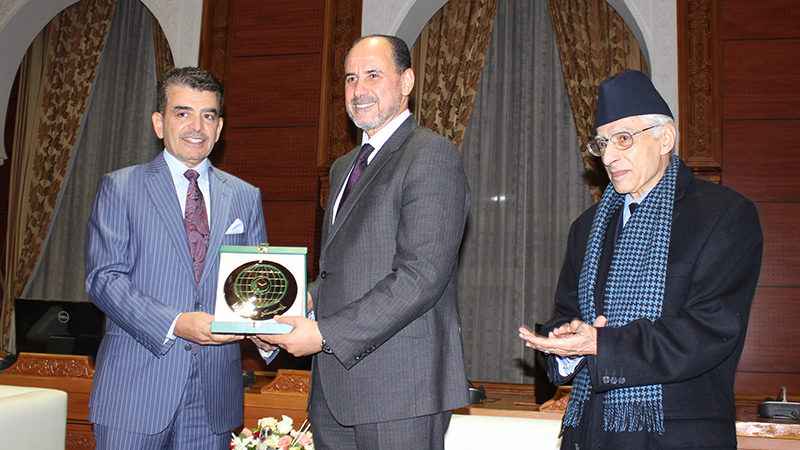
During his participation in the award ceremony of Morocco Book Prize 2019, held by the Moroccan Ministry of Culture, Youth and Sports, under the high patronage of His Majesty King Mohammed VI, Dr. Salim M. AlMalik, ISESCO Director General, after presenting the Prize to one of the winners, announced his initiative to hold the award ceremony of the next year’s edition of the Prize at the Organization’s headquarters in Rabat. The initiative was largely appreciated by the participating audience made up of intellectuals and members of the diplomatic corps in Morocco.
At the invitation of Mr. El Hassan Abyaba, Minister of Culture, Youth and Sports, Government Spokesperson, Dr. AlMalik attended the ceremony along with Mr. André Azoulay, Advisor to His Majesty the King of Morocco. During his friendly discussion with ISESCO Director General, Mr. Azoulay reaffirmed his great respect for the Organization and its efforts and expressed his willingness to cooperate with its General Directorate.
It is worth mentioning that the Prize covers the following categories: poetry, story-telling and narrative, literary creation in Amazigh language, youth and children’s literature, social sciences, translation, literary, artistic and linguistic studies, and studies in the field of Amazigh culture.
The award ceremony took place today evening at the National Library in Rabat.
The Director General of the Islamic Educational, Scientific and Cultural Organization (ISESCO), Dr. Salim M. AlMalik, stated that the present juncture in the history of the Islamic world gives rise to greater responsibilities to tackle challenges and require constant attention to adapt to and keep abreast of changes, as part of a new innovative and comprehensive vision, and through scientific approaches and an anticipatory culture.
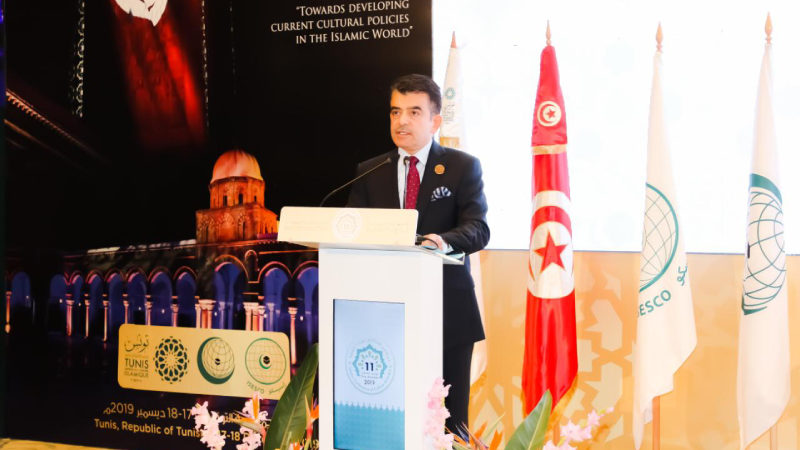
In his address at the opening of the 20th Meeting of the Secretaries General of Arab states’ National Commissions for Education, Science and Culture, held today in Tunis, Republic of Tunisia, ISESCO Director General underlined that “the tough challenges faced by the Islamic world should not shatter our hopes and discourage us from working. A glimmer of hope is always in the horizon as long as there are good initiatives, firm resolve and good anticipation of the future, as Ibn al-Muqaffa says: whoever travels aimlessly, his mount will let him down”.
In addition, Dr. AlMalik stated that advancing the civilizational project in the Arab-Islamic world hinges on updating educational systems; promoting science, technology, innovation and creativity; and renewing policies specific to culture, communication and information. He added that that this civilizational project embodies the collective objective of joint Arab-Islamic action in the fields closely connected to the elaboration of development policies and knowledge systems.
In the same vein, ISESCO Director General pointed out that ISESCO’s new development vision, whose broad-lines are contained in the Medium-Term Strategic Plan (2020-2029), adopts the slogan “Building Systems… Making Minds” and that it will be implemented as part of a forward-looking approach that aims to accomplish ISESCO’s mission and desired objectives. He highlighted that the vision consists of making of ISESCO a beacon of global outreach in the fields of civilizational edification, knowledge progress, with the mission of elaborating development policies and building knowledge and innovation systems, and providing expertise, technical counsel and institutional support.
Moreover, Dr. AlMalik urged Member States to be more effective, be makers of decisions instead of passive observers and achieve their autonomy as dependency, he maintained, kills ambitions and aspirations and breaks wills. He also reaffirmed that from now on, ISESCO will never propose programmes and workshops but rather will wait for the propositions of National Commissions, while taking into consideration their outcomes and impact assessment. He explained that each Commission lives the reality of its country and is well aware of its needs and requirements, while promising that ISESCO would be at the level of expectations of National Commissions only when it receives their support and the one of their countries.
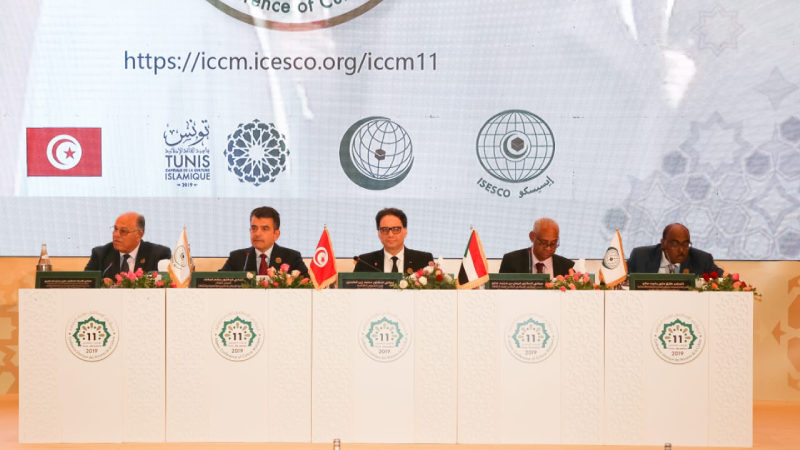
The Fifth Meeting of International Organizations: ALECSO, ISESCO and ABEGS concluded its proceedings today in Tunis, Republic of Tunisia. The meeting kicked off yesterday under the theme “From Cooperation to Partnership”, with the participation of Dr. Salim M. AlMalik, Director General of the Islamic Educational, Scientific and Cultural Organization (ISESCO); Dr. Ali bin Abdul Khaliq Al-Karni, Director General of the Arab Bureau of Education for the Gulf States (ABEGS); and Dr. Mohamed Walad Amor, Director General of the Arab League Educational, Cultural and Scientific Organization (ALECSO).
At the close of today’s session, the parties adopted the final report of the meeting, which included changing the name of this event to “Cooperation Meeting of ALECSO, ISESCO and ABEGS” starting from the next meeting. The final report also stated that, given its being a periodic meeting, the sixth session will be held in Riyadh, in October 2020, while welcoming the offer of ABEGS to host this meeting at its headquarters in Riyadh, Kingdom of Saudi Arabia.
The closing session reviewed ways to foster partnership among the three organizations in concrete field actions for the benefit of Member States, in conformity with the new forward-looking vision of the three organizations’ respective directors general. In this connection two papers were presented, namely “From Cooperation to Partnership”, by the expert Dr. Abdul-Salam Al-Jufi, and “Ways and Mechanisms to Foster Partnership among International Organizations and National Commissions”, by Mr. Mohamed Ghemari, Director of the Secretariat of the Executive Council, General Conference and Specialized Ministerial Conferences at ISESCO.
The two papers underscored that the three organizations are facing various common challenges including illiteracy, rapid technical advancement, new trends in education, and need to give more attention to programmes of publicizing Arab Islamic identity and its position within human identity; and stated that adequate tackling of such challenges requires joining the three organizations’ efforts as part of effective partnership.
In addition, the two papers proposed drafting a joint strategic vision to achieve coordination, complementarity and benefiting from cooperation with international organizations; and agreeing on implementing joint programmes and projects and determining mechanisms for following up, assessing and publicizing them. The two papers also called for promoting the existing cooperation between the three organizations and National Commissions, especially at the level of planning and implementing programmes for the benefit of Member States; and developing such partnership in terms of programmes as well as at the technical and financial levels.
Dr. Salim M. Almalik, Director General of the Islamic Educational, Scientific and Cultural Organization (ISESCO), began his first visit to Member States by meeting with His Majesty Sultan Hassanal Bolkiah of Brunei Darussalam, on Thursday, at Nurul Iman Palace. During this audience, the two parties reviewed the new ISESCO vision and the development steps drafted in the Organization’s plans and strategies; and the proposed innovative mechanisms to support ISESCO’s financial sustainability, most notably through setting up waqfs and holding donor forums.
In this regard, ISESCO Director General hailed Brunei Darussalam’s role in supporting ISESCO and promoting joint Islamic action, reaffirming keenness to render Brunei a regular destination for holding international symposia and hosting some ministerial conferences that falls within the realm of ISESCO’s competence.
The Director General also lauded the celebration of Bandar Seri Begawan as Capital of Islamic Culture for 2019, and the programmes and activities implemented and planned for this occasion.
It is worth noting that since his appointment, based on the nomination of the Kingdom of Saudi Arabia and the endorsement of the Third Extraordinary Session of ISESCO General Conference (9 May 2019, Makkah Al-Mukarramah), Dr. Salim M. Almalik has been working on turning ISESCO, established on 3 May 1982, into an international beacon in the fields of education, science, culture and communication.
Moreover, the notable success in organizing the Eighth Islamic Conference of Environment Ministers, held at ISESCO headquarters, on 2-3 October 2019, is a striking example of the transition the Organization currently witnesses. The conference saw the participation of a large number of Member States and regional and international organizations active in the field of environment; and issued key resolutions that set a forward-looking roadmap to protecting the environment and fostering sustainable development in the Islamic world.
The King of the Kingdom of Morocco, Mohammed VI, commanded the efforts invested by the Islamic Educational, Scientific and Cultural Organization (ISESCO) in the promotion of multi-faceted joint Islamic action, namely in the environmental field, thanks to its largely important academic, cultural and religious dimensions necessary to achieve sustainable development and protect the environment.
This came in a message His Majesty addressed to the participants in the Eighth Islamic Conference of Environment Ministers, which kicked off today morning, at ISESCO headquarters in Rabat, under His Majesty’s high patronage.
In his message, His Majesty King Mohammed VI reiterated his congratulations to Dr. Salim M. AlMalik on his appointment as ISESCO Director General and wished him every success in his new mission.
His Majesty also stated that Morocco has taken the first steps toward setting up the Islamic Academy for the Environment and Sustainable Development as being a an ambitious academic project that aims to deepen academic thinking, raise awareness about the current and future environmental and development challenges and determine how to tackle challenges in the areas of governance, science, technology and capacity-building. In addition, His Majesty revealed that one of the Academy’s objectives is to be a leader in the field of sustainable development, while being keen on using working methods inspired by Islamic culture with regards to exploiting natural resources.
“The fact that necessary measures must be taken to ensure that the Academy is affiliated with the Organization of Islamic Cooperation (OIC) has been emphasized. This would enable the Academy to use international cooperation mechanisms in order to ensure optimal performance and play its role fully within the OIC by interacting with similar regional and international institutions”, his Majesty added.
In addition, the royal message pointed out that the issues pertaining to the environment and sustainable development are among the major challenges faced by the world, citing the fact that many international studies point to an unprecedented depletion of natural resources, a dramatic rise in pollution levels and a major disruption of the global environmental balance. This situation, His Majesty added, has serious and alarming consequences for the planet today, including evident adverse impacts on the economic, social and health situation.
In this vein, His Majesty underscored that pressing environmental problems and their negative effects, on which political and geographical borders have no bearing, can be tackled through close cooperation between states and that no single country can effectively address these problems on its own, whatever its capacities.
The royal message also touched on the efforts Morocco delivers to develop the mechanisms specific to environmental action. In this regard, His Majesty stated that his country had embarked on a collective mobilization process, domestically and at the international level and had been pursuing a proactive policy for the preservation of the environment, through mustering energies and pooling efforts for the achievement of sustainable development, in which the preservation of the environment is mainstreamed in all development plans and sectoral development strategies. He also added that enshrining the right to a safe environment in the Constitution was one more step that established Morocco’s resolute commitment to environment preservation.
The royal message also highlighted Morocco’s involvement in accelerating the achievement of the UN Sustainable Development Goals 2030 by the adoption of the National Strategy for Sustainable Development, for which a participatory approach was used to integrate socioeconomic and environmental dimensions based on a clear constitutional and legal frame of reference.
As part of this strategy, His Majesty asserts, a framework for governance and a set of sectoral plans for sustainable development have been established with a view to promoting the transition to a green economy by 2030.
His Majesty announced the creation of a competence center on climate change as a means to accompany and support national actors and promote South-South cooperation, particularly with Muslim and African countries.
Moreover, His Majesty announced that his country had set for itself the goal of reducing its greenhouse gas emissions by 42% and that this objective would be achieved mostly through the implementation of the National Energy Strategy under which Morocco seeks to increase the share of electricity generation from renewable energy sources through several major pilot projects that concern solar, wind and hydro power.
His Majesty also stressed the importance of collective environmental action and its role in strengthening joint Islamic cooperation through complementarity, coordination and the exchange of know-how and experiences between Muslim countries.
At the close of his message, His Majesty expressed confidence that the constructive academic debate and the appropriate proposals and recommendations that will be made at this important conference will have a positive impact on the promotion of environmental and sustainable development issues in the Islamic world.
Today morning, at the headquarters of the Islamic Educational, Scientific and Cultural Organization (ISESCO) in Rabat, the Eighth Islamic Conference of Environment Ministers (ICEM), kicked off under the high patronage of His Majesty King Mohammed VI of Morocco. the Conference is held by ISESCO, in cooperation with the Ministry of Environment, Water and Agriculture of the Kingdom of Saudi Arabia and the General Authority of Meteorology and Environmental Protection in the Kingdom of Saudi Arabia, under the theme “The Role of Cultural and Religious Factors in the Protection of the Environment and Sustainable Development”.
During the opening session, Mr. Mohamed Laaraj, Minister of Culture and Communication of the Kingdom of Morocco, read out the royal message addressed by King Mohammed VI to the Conference. Afterwards, addresses were given by Dr. Salim M. AlMalik, ISESCO Director General; Mr. Aziz Rabbah, Vice-President of the Eighth ICEM session, Minister of Energy, Mines and Sustainable Development of Morocco; Dr. Yousef Al-Othaimeen, Secretary General of the Organization of Islamic Cooperation (OIC); and Her Royal Highness Princess Soumaya bint Al-Hassan, President of the Royal Scientific Society (RSS) of the Hashemite Kingdom of Jordan.
This session also featured the award ceremony of the Kingdom of Saudi Arabia Award for Environmental Management in the Islamic World (KSAAEM – 2018/2019), during which Dr. Abdulrahman Al-Tariki, President of KSAAEM Higher Committee, General President of the General Authority of Meteorology and Environmental Protection in the Kingdom of Saudi Arabia gave his address. 17 winners from 13 Islamic countries received the Award, divided into the Award’s five categories: best research works in the field of environmental management, best practices in the field of environmental management in the public sector in Member States, best practices in the field of environmental management in the private sector in Member States, best leading practices in the field of environmental management in NGOs that can be replicated in Member States, and best environmentally-friendly Muslim cities.
The opening session brought together a number of ministers from of the Moroccan Government, Environment Ministers from OIC Member States or their delegates, Chairman of ISESCO Executive Council, Director General of the Arab League Educational, Cultural and Scientific Organization (ALECSO), members of the diplomatic corps accredited to Rabat, representatives of many regional and international organizations, political and academic figures, and representatives of the local, Islamic and international media outlets.
It is worth noting that the Conference will discuss a number of reports and draft documents pertaining to the issues of the environment and sustainable development in the Islamic world, namely the Report of the 5th Meeting of the Islamic Executive Bureau for the Environment; Report on ISESCO’s Efforts in the Fields of Environment and Sustainable Development between the 7th and 8th Sessions of the Islamic Conference of Environment Ministers; and the Progress Report on the Creation of the Islamic Academy for the Environment and Sustainable Development. The Conference will also discuss the Report on the Kingdom of Saudi Arabia Award for Environmental Management in the Islamic World (KSAAEM); the Report on the Programme of the Celebration of the Islamic World Environmentally-Friendly Capitals; and the Report on the Executive Action Plan for Natural Disaster Risk Reduction and Management in Member States.
Likewise, the Conference will also review the following projects and documents: the Project of the Establishment of the Islamic Network for Environmental Action and Sustainable Development; Draft Strategy for the Promotion of the Role of Cultural and Religious Factors in Protecting the Environment and Achieving Sustainable Development in the Islamic World; and the Draft Guidance Document on Strengthening the Role of Youth and Civil Society in the Protection of the Environment and Achievement of Sustainable Development.
The statements and reports of the heads of delegation of Member States and international organizations will be also presented, the members of the Islamic Executive Bureau for the Environment elected; and the date and venue of the 9th Conference session set.
The Islamic Conference of Environment Ministers holds its 8th session 17 years after its first, held in Jeddah, Kingdom of Saudi Arabia, in June 2002, which laid the ground for joint Islamic action in the field of environment by adopting the founding document entitled “Jeddah Commitments for Sustainable Development”.