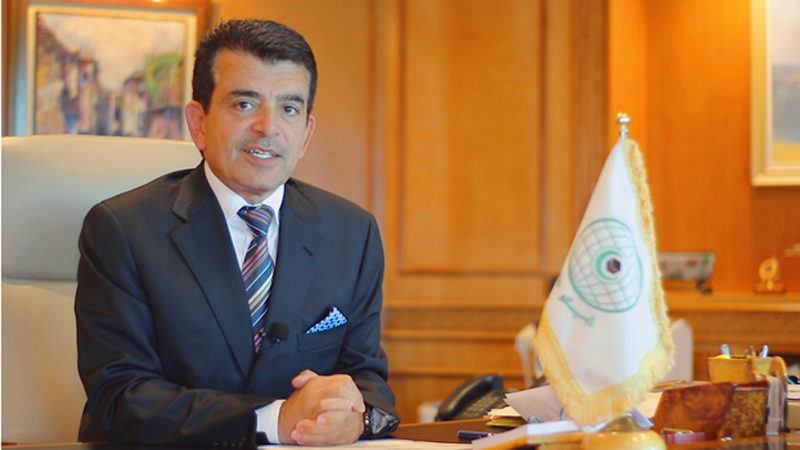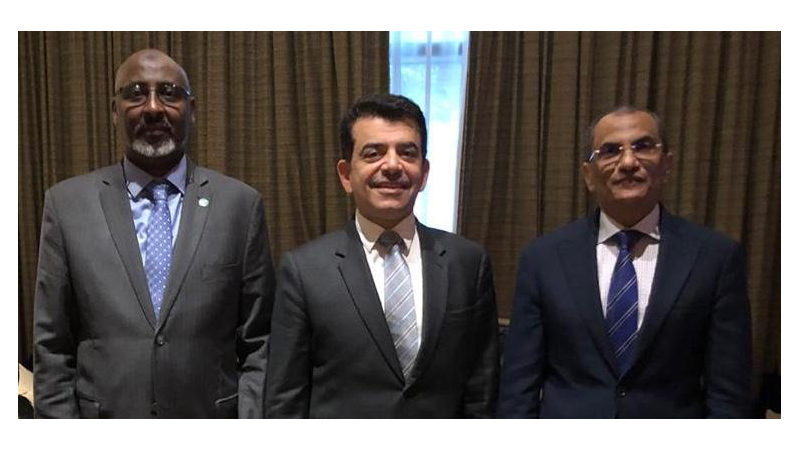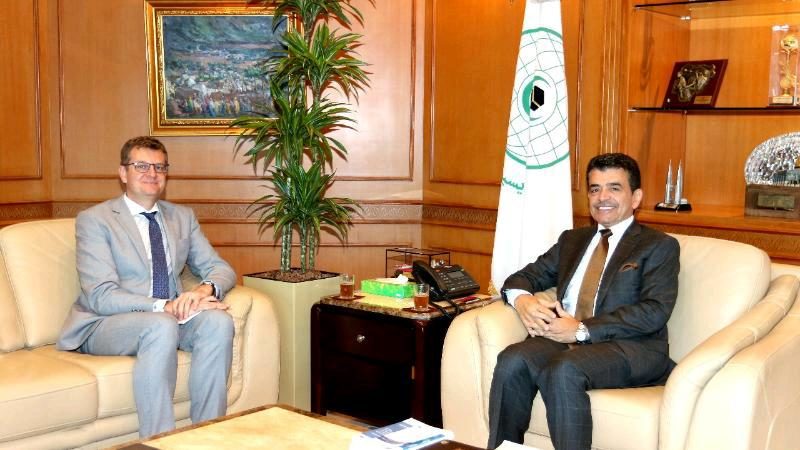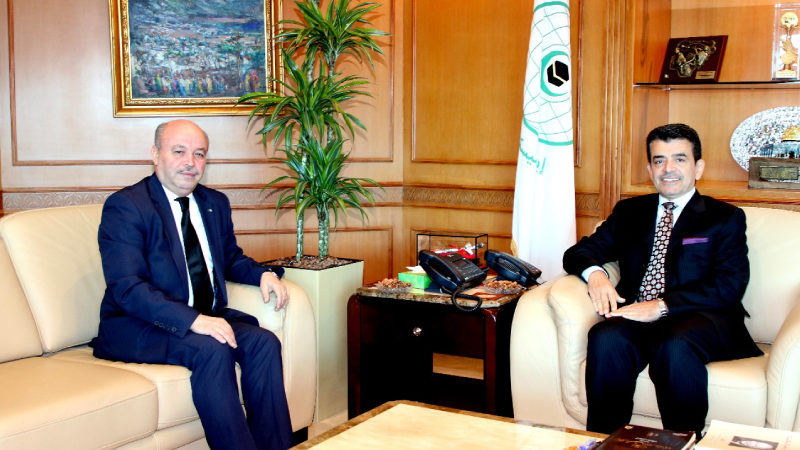
The First Lady of Senegal, Mrs. Marème Faye Sall, at
her residence, received the Director General of the Islamic Educational,
Scientific and Cultural Organization (ISESCO), Dr. Salim M. AlMalik, during his
current visit to Dakar. The reception was attended by Mr. Mamadou Talla,
Minister of Education and Literacy, President of the Senegalese National
Commission.
During this meeting, Dr. Salim M. AlMalik reviewed
ISESCO’s new vision, which pays major attention to social and human dimensions
and empowerment of various categories to live in decent conditions. The two
parties also explored ways to promote cooperation between the Organization and
“Servir le Sénégal” Foundation, which provides various services to citizens in
need.
The two parties also agreed to organize a medical,
educational and social caravan in 2020 in Senegal, equip a number of childcare
centers with educational tools, and train social workers in these centers to
provide integrated social, educational and psychological services that are
sensitive to the needs of these categories.
The meeting was attended from ISESCO by Dr. Ahmed Said
Ould Bah, Director of External relations and Cooperation, and Mrs. Ramata
Almamy Mbaye, Director of Human Sciences.
It is worth mentioning that the First Lady of Senegal
created “Servir le Sénégal” Foundation in 2012, to provide humanitarian
services for citizens in need. The Foundation is run by Mrs. Sall, along with
Senegalese volunteers and others, who make major efforts to support patients in
urgent need for dialysis and renal care, in addition to providing some basic
life assistance to several remote villages.
The
President of the Republic of Senegal, H.E. Mr. Macky Sall, at the Presidential
Palace in Dakar, received Dr. Salim M. AlMalik, ISESCO Director General, who is
in Senegal at the beginning of an official visit that also includes Niger and
Guinea.
At the
outset of the meeting, Dr. AlMalik congratulated the President of the Republic
for the progress witnessed in Senegal in consistency with its regional role and
significant position in the African continent. He also reviewed ISESCO’s new
vision and priorities to meet Member States’ needs in the fields of education,
science and culture and consolidate and support their efforts towards achieving
sustainable development.
Moreover,
ISESCO Director General evoked the Waqf Fund Project to secure sustainable
resources for financing the Organization’s projects and programmes to ensure
that Member States benefit to the fullest from them. Dr. AlMalik reiterated
ISESCO’s support to Quranic schools in Senegal which receive a special
attention from President Sall.
For his
part, the President of the Republic lauded the efforts made by ISESCO Director
General to develop the Organization and enhance its roles in supporting Member
States, under its new vision.
He also
expressed the willingness to support and bolster ties with ISESCO and facilitate
its action in Senegal, in the joint cooperation areas of ISESCO and the Senegalese
competent authorities. He also voiced Senegal’s intention to provide financial
and technical support to the Waqf project, while commending the promising
prospects of the Organization’s future action and projects.
The meeting
was attended by Dr. Ahmed Said Bah, Director of External Relations and
Cooperation, and Ms. Ramata Almamy Mbaye, Director of Social and Human
Sciences.
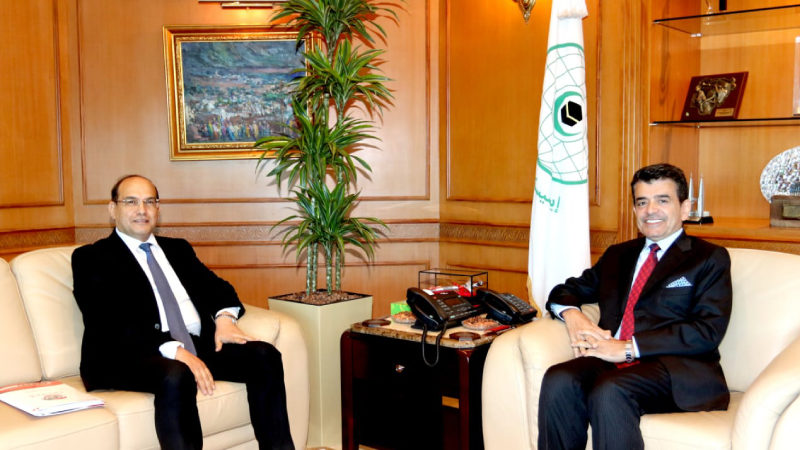
Dr. Salim M. AlMalik, Director
General of the Islamic Educational, Scientific and Cultural Organization
(ISESCO), explored with Mr. Mamadou Talla, Minister of Education and Literacy
of Senegal, President of the Senegalese National Commission, the areas of
cooperation between the Organization and the Ministry in the field of education
and training the educational staff.
During this meeting, held as part of
the official visit of ISESCO Director General to Senegal, Dr. AlMalik reviewed
the new vision of ISESCO, which makes of ISESCO a house of expertise for the
Islamic world in its areas of action, empowers youth, women and children to
exercise their educational, scientific, cultural, technological and
environmental rights. In this context, ISESCO agreed to support the non-formal
education in Senegal through providing expertise and technical advice, and
training teachers and educational supervisors.
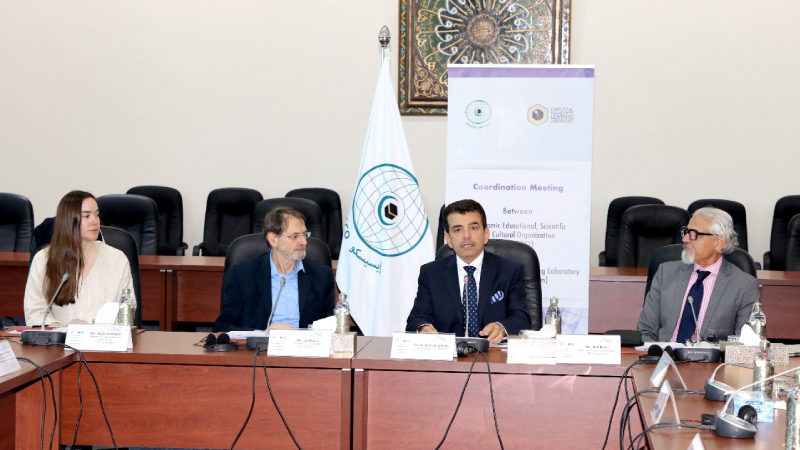
The two parties also agreed to form a
joint commission of ISESCO and the Senegalese Ministry of Education and hold
its meeting at ISESCO headquarters in Rabat so as to develop an executive
cooperation plan and identify the follow-up and coordination mechanisms.
The meeting was attended from ISESCO
by Dr. Ahmed Said Bah, Director of External Relations and Cooperation, and Ms.
Rahmata Almamy Mbaye, Director of Human and Social Sciences.
As part of his official visit to the
Republic of Senegal, Dr. Salim M. AlMalik, Director General of the Islamic
Educational, Scientific and Cultural Organization (ISESCO), made a special
visit to Dr. Ahmed Mukhtar Ambu, former director-general of UNESCO, at
his housein Dakar, in recognition of his great services to the Islamic
world during and after his mandate at UNESCO.
During this meeting, Dr. AlMalik
reviewed the new vision and future action strategy of ISESCO, and asked Dr.
Ambu to express his opinions and make proposals so as to support this vision.
Dr. Ambu highly commended this vision given his experience at UNESCO, and made
some proposals for ISESCO’s action in Africa.
The meeting was attended from ISESCO
by Dr. Ahmed Said Bah, Director of External Relations and Cooperation, and Ms.
Rahmata Almamy Mbaye, Director of Human and Social Sciences.
It is worth mentioning that Dr. Ambu had
served in many positions in the sector of education in Senegal before he was
appointed as Minister of Education and Culture in 1957. He then headed many
ministries until 1970. He was elected at
UNESCO Executive Council in 1966, and was appointed as assistant director-general
in 1970, and as UNESCO director-general in 1974. He was reelected for a second
mandate in 1980 and remained in office until 1987.
As part of the celebration of the Islamic
Educational, Scientific and Cultural Organization (ISESCO) on the occasion of
the World Arabic Language Day, held today at its headquarters under the theme
“Arabic Language and Artificial Intelligence” in cooperation with the Saudi
Cultural Attaché in Rabat, the Association of Institutions of Teaching Arabic
Language to Non-Arabic Speakers, and the Moroccan Association of Arabic Calligraphy,
a symposium was held under the theme “Teaching Arabic Language in Digital School”.
The symposium was moderated by Dr. Abdullah
Al-Obeid, President of the Association of Institutions of Teaching Arabic Language
to Non-Arabic Speakers. It mainly discussed the relationship of Arabic language
with modern digital applications and programs and their importance in teaching
and learning Arabic.
At the outset, Dr. Mohamed El Hannach,
Teacher of General Linguistics and Arabic language at Sidi Mohamed ben Abdellah
University in Fes, President of the International Agency of NLP (IA4NLP) of the
Kingdom of Morocco, made a presentation entitled “Arabic language and digital
applications: teaching platforms” wherein he tackled the digital educational
resources in Arabic language for non-Arabic speakers for keeping up with future
developments, as well as the digitalization of teaching platforms and its
benefits and drawbacks within the technological development.
Afterwards, Dr. Tarek Makhlouf,
Director of Granada Editions based in Paris, made a presentation on “the
Institution and its educational models for enhancing students’ level”. Then the
audience listened to another presentation by Mr. Reda al-Rejibi, Director of Teaching
Division at Granada Editions, on the platform of teaching Arabic language
‘Anas Digital’.
Dr. Hicham bin Saleh al-Qadi, representative
of Arabic Linguistics Institute, Assistant Teacher of Applied Linguistics at
King Saud University in Riyadh, tackled the issue of Artificial Intelligence in
his presentation on the role of AI in teaching languages in general and Arabic
language in particular.
The floor was then given to Dr. Ahmed Alaoui Abdelaoui, staff
member of the Faculty of Arts and Human Sciences of Sidi Mohamed ben Abdellah
University in Fes, to make his presentation on the role of the inclusive
language in ensuring the cultural security of Arab countries. He also stressed
the importance of language as a tool for unifying society given its communication,
cultural, knowledge, historical and civilization roles that keep society coherent
and harmonious. Besides, he raised the problematic of multilingualism in the
Arab world, and stressed the need to rationalize each language in its natural
environment within the linguistic system of the Arab world.
On her part, Dr. Hakima Shami, Director of the Centre of
Documentation and Cultural Activities at the Regional Delegation of Islamic
Affairs in Casablanca, made a presentation on “Arabic calligraphy and the
Moroccan specificity”. She highlighted the emergence of Arabic calligraphy in
Morocco, the beginning of Moroccan calligraphy, and the most famous types of
Moroccan calligraphy. She concluded her presentation by reminding that “Arabic
calligraphy and the Moroccan specificity is a call for reconciling with our
mother tongue. It is a problematic of communication between the past and the
present behaviors in line with the modern era’s requirements.
At the close of the symposium, the floor was given to the
audience, who made fruitful interventions and raised many questions.
**The Organization works with the Islamic
Development Bank (IsDB) and ALECSO to draft a reference framework for teaching
Arabic
**It is crucial to benefit from
information technology to facilitate teaching Arabic to non-Arabic speakers
The Director General of the Islamic
Educational, Scientific and Cultural Organization (ISESCO), Dr. Salim M.
AlMalik, reaffirmed that promoting Arabic in its educational, scientific, and
media dimensions is a shared responsibility, which we must all shoulder, each
from his/her position.
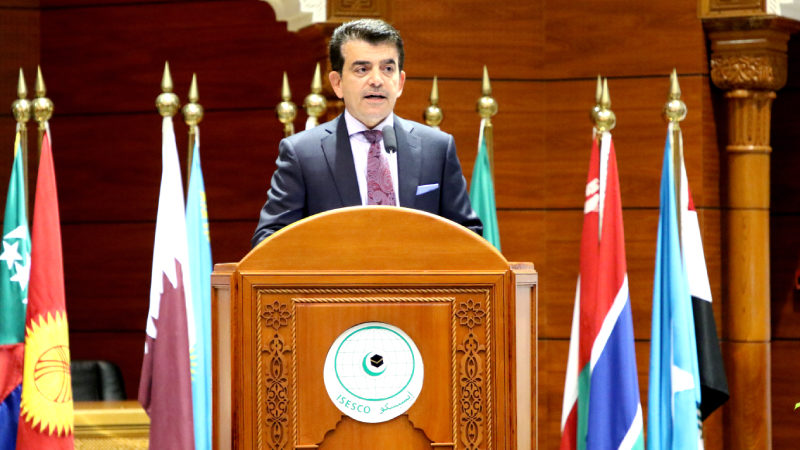
In his address at the opening of ISESCO’s
celebration of World Arabic Language Day, which kicked off today at the
Organization’s headquarters, under the theme: “Arabic and Artificial
Intelligence”, Dr. AlMalik stated that, as part of its new vision, ISESCO
directs attention toward renewing the curricula, methods and tools of teaching
Arabic to non-Arabic speakers. This attention stems from the Organization’s conviction
in the need to benefit from the tremendous opportunities ICT provides with
regard to facilitating teaching and learning Arabic in different cultural
environments.
In addition, the Director General revealed
that ISESCO is currently working with the Islamic Development Bank (IsDB) and
the Arab League Educational, Cultural and Scientific Organization (ALECSO) to
lay the methodological foundations and draft a comprehensive plan for devising
a joint reference framework for teaching and learning Arabic, which is hoped to
be completed in the upcoming two years. This major civilizational initiative is
expected to fill in a methodological gap in the Arabic teaching programmes, and
assess the competencies of its learners.
Dr. AlMalik also wondered if the
Islamic world sufficiently exerted efforts to allow Arabic to keep up with the
rapidly-changing changes, stressing that the Islamic world is before a
situation that requires taking cognizance and drawing lessons: despite its
distinctive aspects among major world languages, Arabic lost the head start and
leadership in disseminating sciences, knowledge and innovations.
Likewise, he warned that the digital
content written in Arabic in different fields does not exceed 3% of the total
world contents on the Internet. He added that proactive studies addressing the
repercussions of the digital revolution and the Internet of things state that
the patterns of formal, teacher-based schools will witness drastic and rapid
change in the next two decades, moving towards an educational system based on
digital software and applications, a change already taking shape in advanced
countries through digital classrooms and the system of smart and open schools.
The Director General concluded his
address with a poem he wrote on Arabic language in the hope for a brighter future
for it.
The Director
General of the Islamic Educational, Scientific and Cultural Organization
(ISESCO), Dr. Salim M. AlMalik, took part in the closing ceremony of the 7th
edition of the International Festival of Cultural Diplomacy and Poetry,
organized by the Moroccan Poetry Association (RMP), on Thursday 26 December
2019, at Bahnini Hall, the Ministry of Culture, Youth and Sports, Rabat.
The ceremony
featured the awarding of the World Prize of the Ambassador of Cultural
Diplomacy to the poet Mr. Khaled Fateh Al-Rahman to reward his poetic works and
tireless action to bolster brotherly ties between the Sudan and Morocco
throughout his mandate as Ambassador of the Republic of the Sudan to the
Kingdom of Morocco.
The ceremony
was opened with a welcoming address by Mr. Ahmed Taghi, President of RMP, who
underscored the importance of cultural diplomacy and the role of the
Association, as a cultural and artistic association, in promoting cultural
diplomacy and celebrating poetry.
Then, Mr. Hussam
El-Din Eltayeb, Chargé d’Affaires of the Sudanese Embassy in Rabat, delivered
an address thanking the RMP for having honored Ambassador Khaled Fateh
Al-Rahman to whom he wished him every success.
Dr. AlMalik
also made an address lauding Ambassador Fateh Al-Rahman, read some verses which
he composed on the occasion and presented the honor shield to the Ambassador. Mr.
Hazim Al Khateb, Ambassador of Jordan to Morocco, also presented a certificate
of appreciation to the Ambassador.
At the close
of the ceremony, Ambassador Fateh Al-Rahman delivered an address thanking the
audience and read out a poem in tribute to Morocco.
Dr. Salim M. AlMalik, Director
General of the Islamic Educational, Scientific and Cultural Organization
(ISESCO) concluded his first official visit to the Islamic Republic of
Mauritania, which started on 22 December 2019 and included meetings with senior
Mauritanian officials, attending the award ceremony of Chinguetti Prize 2019, and
visiting Chinguett Modern University.
After being received by H.H. Mr. Mohamed Ould Cheikh Ghazouani, President of the Islamic Republic of
Mauritania, at the Presidential Palace in Nouakchott, Dr. AlMalik met the Prime
Minister, Mr. Ismail Bedde Cheikh Sidiya, and together they stressed the
importance of promoting coordination and consultation so as to implement
ISESCO’s initiatives launched for the benefit of Mauritania, including ISESCO’s
willingness to support Chinguetti Prize, schedule Nouakchott on the programme
of the Capitals of Islamic Culture, contribute to the success of the
celebration of the ancient towns in Mauritania, establish a training institute
for imams, and launch Mahdara’s initiatives while reaffirming the importance
and role of such initiatives in contributing to the development of Mauritania.
Besides, ISESCO Director General met
the Mauritanian Minister of Foreign Affairs, Mr. Ismael Ould Cheikh Ahmed. This
meeting explored ISESCO’s initiatives, agreed to look for strategic
partnerships to support the development projects in Mauritania within ISESCO’s
fields of action, and reaffirmed the importance of the cultural diplomacy and
multilateral cooperation in achieving the joint objectives as part of ISESCO’s
initiatives for the benefit of Mauritania.
Mr. Ismail Sidiya thanked Dr. AlMalik
for these initiatives and expressed the willingness of the official and
competent parties in Mauritania to support ISESCO in this regard.
ISESCO Director General also had
meetings with Dr. Sidi Mohamed Ould Ghaber, the Minister of Culture,
Handicrafts and Relations with the Parliament of Mauritania, and Mr. Dah Ould
Sidi Ould Amar Taleb, Minister of Islamic Affairs and Traditional Education of
Mauritania. The two meetings explored the development of cooperation between the
Organization and Mauritania within ISESCO’s fields of action.
In addition, Dr. AlMalik made a visit
to Chinguett Modern University, which receives ISESCO’s support and hosts one
of its Academic Chairs. One of the University’s Amphitheatre will be named
after ISESCO. Chinguett Modern University is a private university with four
departments, namely Islamic Studies, Sharia and Law, Islamic Economics, and
Arabic Language and Literature.
H.H. Mr. Mohamed Ould Cheikh Ghazouani, President of the Islamic Republic of
Mauritania, today at the Presidential Palace in Nouakchott, received Dr. Salim
M. AlMalik, Director General of the Islamic Educational, Scientific and
Cultural Organization (ISESCO), who is in a visit to Mauritania upon an
invitation from Dr. Sidi Mohamed Ould Ghaber, Minister of Culture, Handicrafts
and Relations with the Parliament of Mauritania, to attend the award ceremony
of Chinguetti Prize 2019 as a guest of honor.
At the outset of the meeting, Dr. AlMalik
thanked President of Mauritania for the warm welcome, commended Chinguetti
Prize and its role in supporting and encouraging scholars and intellects to be creative,
and reviewed ISESCO’s new vision, which pays special attention to the cultural
heritage and scientific research as two foundations of development.
Besides, Dr. AlMalik highlighted a
number of initiatives that ISESCO intends to launch in Mauritania, including
the importance of Mahdara in the Islamic world as it constitutes a great and
unique heritage of Mauritania.
The meeting also tackled ISESCO’s initiatives
to proclaim Nouakchott as a Capital of Islamic Heritage given its rich heritage
and history as well as its intellects and historians.
Dr. AlMalik stated that the four
ancient towns in Mauritania have had their share of ISESCO’s attention through
their preservation to be an exemplary model for Muslim countries. “Five Mauritanian
heritage sites have been inscribed by the Islamic World Heritage Committee. We
are hopeful that we will inscribe more tangible and intangible heritage”, he
added.
H.E. Mr. Mohamed Ould Cheikh Ghazouani also expressed his appreciation of
ISESCO’s initiatives while reaffirming his country’s willingness to cooperate
with the Organization in their implementation so as to embody the partnership
of the two parties.
The meeting was attended by Dr. Sidi
Mohamed Ould Ghaber, Minister of Culture, Handicrafts and Relations with the
Parliament of Mauritania; as well as Dr. Ahmed Said Bah, Director of External
Relations and Cooperation; and Mr. Adel Bouraoui, Supervisor of the Directorate
of Education from ISESCO.
The Islamic Educational, Scientific
and Cultural Organization (ISESCO) adopted the inscription of Rabat, capital of
the Kingdom of Morocco; Tunis, Kairouan and Mahdia, the Republic of Tunisia; the
historical region of Cairo in the capital of Egypt; and Kasbah region in
Algiers, Republic of Algeria; as well as Nizwa, Sultanate of Oman, on the Islamic
World Heritage List.
This adoption was on the Final Report
of the 11th Islamic Conference of Culture Ministers, held in Tunis
on 17-18 December 2019 under the theme “Toward the Development of Current
Cultural Policies in the Islamic World”, with the participation of 50 countries
and 15 regional and international organizations.
Dr. Salim M. AlMalik, ISESCO Director General,
had requested the Ministers of Culture and the competent parties in Member
States to continue the submission of the technical files to inscribe all the
tangible, intangible, natural and industrial heritage sites in their countries
on the Islamic World Heritage List.
In his address at the Conference’s
opening session, Dr. AlMalik stated that ISESCO established a special unit for
the inscription of heritage sites in Muslim countries according to strict
scientific and international standards. ISESCO also signed a cooperation
agreement with UNESCO on the inscription of heritage sites of Member States on
the World Heritage List.
Besides, Dr. AlMalik underlined that
heritage and cultural heritage in many Member States are subject to
disappearance, destruction and looting as the List of World Heritage in Danger
includes 37 sites in Muslim countries out of 54 sites accounting to almost 70%
of the sites in danger.
ISESCO Director General also stressed
the importance of translating the cultural unity and solidarity regarding the
preservation of the Islamic cultural heritage into a programme to be supervised
by ISESCO to jointly inscribe a number of exemplary historical and
civilizational routes (Hajj route, routes of trade caravans, and the routes of
travelers, scholars, students and manuscripts, etc) on the Islamic World
Heritage List while reaffirming that ISESCO adopted this action within its new
vision.