The Islamic World Educational, Scientific
and Cultural Organization (ICESCO), acknowledges the groundbreaking decisions
and productive outcomes of the Extraordinary Virtual G20 Summit, convened by
the Kingdom of Saudi Arabia.
The Kingdom of Saudi Arabia assumes the
presidency of the current session to counter the spread and mitigate the effect
of the coronavirus pandemic (Covid-19). ICESCO affirms its full support to the Summit’s
decisions and response to fight this deadly contagion ravaging the world today.
ICESCO congratulates the Custodian of
the Two Holy Mosques, King Salman bin Abdulaziz Al Saud, and Crown Prince,
Mohammed bin Salman bin Abdulaziz Al Saud, on the success of this historic
Summit. It further galvanizes its willingness to contribute to its objectives
and implement its initiatives towards extending ICESCO’s array of resources and
specialized expertise at the disposal of the Summit’s Presidency.
Likewise, ICESCO calls on governments,
competent parties, and international organizations to engage and muster support
for the success of this summit. It
enjoins all to orchestrate efforts, intensify measures and align each goal to effectively
end this crisis, envisioning the restoration of normal day to day life and the resumption
of the delivery of educational, scientific and cultural initiatives and services
for the benefit of all.
“ICESCO Digital Home”, a new initiative launched by the Islamic
World Educational, Scientific and Cultural Organization through which the
Organization continues the series of practical initiatives and guidance it has
launched in several Member States since the early days of the coronavirus
outbreak (COVID -19).
Through this initiative, ICESCO aims to support the efforts
deployed by the Member States and the international community as a whole to
counter this pandemic by proposing the best solutions to address the current
and emergency circumstances. It provides for the most efficient and flexible
state of the art technologies that can work under the lockdown situations and
address its repercussions on areas of education, science and culture.
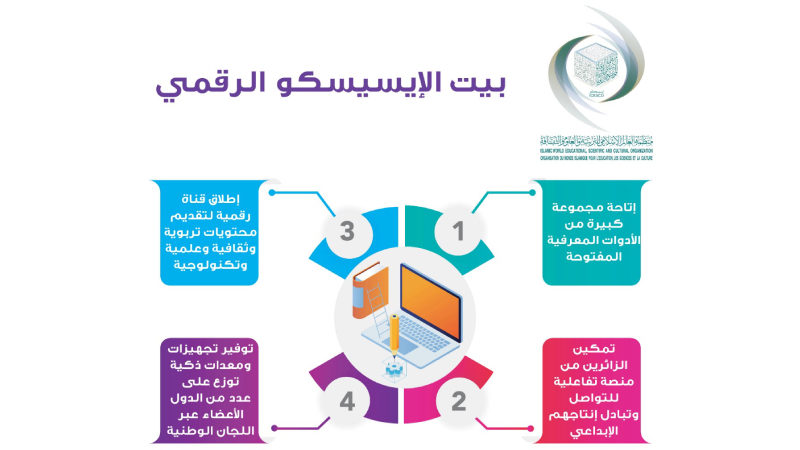
“ICESCO Digital Home” initiative includes a variety of
integrated measures of immediate field support, through modern technological
means, to include workable communication tools and comprehensive digital
contents, as follows:
1-Setting up number of open knowledge tools consisting of the
latest software applications needed by students in schools, higher education
institutions and universities, as well as by researchers, teachers and digital
learning contents developers. These tools also include pedagogical guides for
all levels, multidisciplinary interactive learning contents for the benefit of
students of different age categories, in addition to general knowledge,
cultural industries and intellectual contents.
2-Providing “ICESCO Digital Home” visitors with an interactive
platform for communicating and exchanging creative and innovative products.
This platform includes attractive contents for raising awareness about the
protection against the coronavirus, drawing on the instructions and guidelines
as advised by specialists. This platform caters to all its visitors of different
age groups and various specialities.
3-Launching a digital channel providing educational, cultural,
scientific and technological contents that aim to qualify parents
and enhance their pedagogical skills in promoting their roles in the family
educate children on positive and constructive values.
4-Providing smart equipments enhanced by various digital
contents to be sent to several Member States through their National Commissions
for education, science and culture. These comprehensive contents will be
available on ICESCO website (www.icesco.org).
In launching this new digital initiative, the Islamic World
Educational, Scientific and Cultural Organization, provides integrated tools,
resources and contents, with easy accessibility on its website, as it reiterates
its call upon all competent parties in Member States to benefit from them. Additionally, it aims for the unhampered learning
process through alternative means that are consistent with the needs of each
country to mitigate the effect of the covid-19 pandemic. The Organization further
pledges to pursue efforts to promote this strategic initiative, and harness all
its potentials for the benefit of all.
Today, humanity, including the Member
States of the Islamic World Educational, Scientific and Cultural Organization
(ICESCO), is experiencing a trying ordeal not seen for a long
time, at a moment of technological developments and unprecedented scientific breakthroughs
in various fields. The quick emergence and spread of Covid-19 around the globe and
its toll
of thousands of deaths have frightened everyone and caused a state
of panic, horror, and fear.
While civil and military authorities in
Member States are exerting great efforts to contain this pandemic and ensure
the safety of people, fake news and false information proliferate to open
a new front against rumors and lies which further aggravate the repercussions
of this virus and disturb the efforts deployed by governments to reduce the repercussions
of the spread of Covid-19.
In this regards, ICESCO calls upon the
ministries of religious affairs and the competent bodies in Member States to
make use of minarets of mosques and other places of worship to raise people’s awareness
of the precepts and purposes of sharia regarding good hygiene and the
prevention of diseases. The Organization also stresses the importance of
involving religious leaders in awareness-raising campaigns among citizens and disseminating
the messages of reassurance, serenity, and compliance with the safety
instructions given by the official and competent authorities in Member States. Likewise,
ICESCO calls for the need to have a sense of
responsibility, respect the law, promote the values of solidarity
and unity, facilitate the action of the authorities in charge of managing this pandemic
crisis to provide help for patients and verify information
through obtaining it from its reliable and official sources.
Thus, such efforts would surely contribute
to the containment of this pandemic, promote the spiritual safety, raise
awareness of the values of social solidarity and national unity, strengthen the
family
and social relations, rekindle hope among people, bring people
together around the love of Allah and His prophets, and keep beseeching and
asking Allah’s forgiveness, and doing good deeds until this plague is gone and
the Mercy of Allah prevails.
As part of an initiative to show solidarity with the Kingdom of Morocco in
its efforts to face the risk of the spread of Covid-19, the staff members of
the Islamic World Educational, Scientific and Cultural Organization (ICESCO),
belonging to over 20 nationalities, decided to donate 10% of their salaries of
March for the benefit of the private fund, entitled Management Fund of
Covid-19, established by the Moroccan government in implementation of the royal
instructions of His Majesty King Mohammed VI.
Through this initiative, ICESCO’s
staff members expressed their deep thanks and great appreciation to the King,
people and government of the Kingdom of Morocco (Seat Country), for their warm hospitality and good cooperation in the Organization’s action and activities as well
as their day-to-day life.
It is worth mentioning that ICESCO,
in several statements, has reaffirmed its firm commitment to support the
efforts geared toward confronting Covid-19, and implemented a number of
mechanisms to ensure emergency response to the current emergency situations and
the continuity of the educational and
training process, including the provision of prompt logistic support to needy
Member States so as to enable them to have the necessary digital equipment,
establish technical units to record the digital educational materials, provide
them to students at various educational levels, and launch an initiative for
the benefit of vulnerable groups in rural and remote areas in order to promote
the national capacities and health systems on ways to prevent and confront
emergency situations and risks of pandemics by distributing educational and
health bags for prevention and awareness-raising in the field of the fight
against the spread of Covid-19 and all other pandemics.
ICESCO also stressed the need to
promote the values of solidarity and unity among Member States and with other
countries and peoples, and called for the prevalence of the general human
interest in such dire circumstances while reaffirming that the Organization
will follow up the implications of Covid-19 on the educational, scientific and
cultural fields in Member States, and will
provide them with the most efficient ways to support their efforts according to
the latest developments.
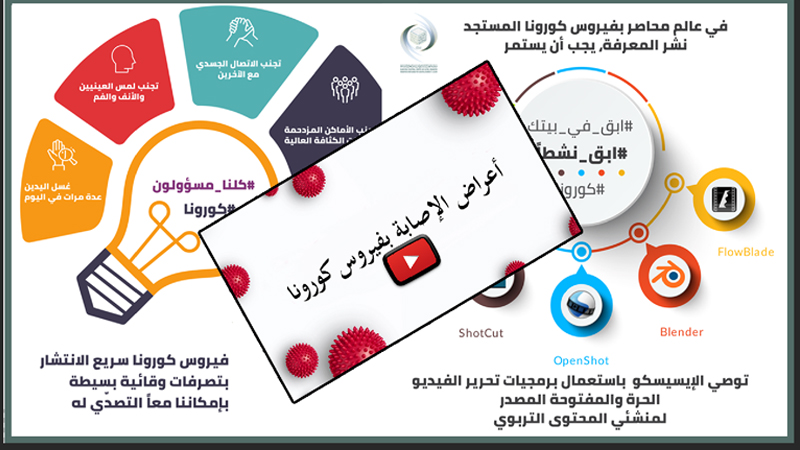
As part of its commitment to support
efforts to combat Coronavirus pandemic (COVID-19), the Islamic World
Educational, Scientific and Cultural Organization (ICESCO) started producing video
clips and infographics to contribute to raising public awareness about the importance
and ways to face this global pandemic and continue working and learning under
these circumstances.
The first video contains a definition of
the virus and shows how it differs from the seasonal flu and provides necessary
protection measures against the pandemic. As for the infographics, the first
lists the most famous free and open source software for editing instructional
videos while the second gives tips on basic preventive behaviors to limit the
spread of Coronavirus.
The Organization will continue producing
multimedia-based materials to propose accessible alternatives for distance
learning. In this regard, it reiterates its call to the competent authorities
in Member States to make use of the available alternatives the Organization
adopted, namely shifts and telecommuting.
In giving effect to the orientations to
support and help Member States’ competent authorities, ICESCO decided to
develop emergency response mechanisms to the urgent situations and ensure the
continuity of education and training, as announced in its yesterday’s
statement.
In this context, the Organization
underscores the primacy of the values of solidarity and unity among Member
States and with all the world’s nations and peoples and calls for prioritizing
humanity’s interest in these trying circumstances.
ICESCO will constantly follow the
repercussions of the spread of Coronavirus (COVID-19) on the educational,
scientific and cultural conditions in Member States. To this end, the
Organization will provide Member States with the most efficient ways likely to
support their efforts as may be required by future developments, while
reiterating its confidence in the ability of the countries of the world to
overcome this crisis and curb its social, economic and humanitarian
consequences.
The Islamic World Educational, Scientific and Cultural Organization
(ICESCO) reaffirms its firm commitment to support the efforts of the
international community and national initiatives to fight the Coronavirus
pandemic (Covid-19), and calls on the competent authorities of the Islamic
World countries to adopt possible alternatives and available mechanisms that
ICESCO is adopting, and calls the competent authorities in Member States to
implement them:
Rotating
shift pattern.
Teleworking system.
In line with the Organization’s commitment to support and assist the
competent authorities in Member States, ICESCO has decided implement a number
of emergency response mechanisms to face the current emergency situations and
ensure the continuity of education and training, namely:
Providing urgent logistical support to the
Member States in need, enabling them to provide the necessary digital equipment
and creating technical units for recording educational digital materials and
making them available to students of different levels of education;
Creating a page on ICESCO website, open to
institutions, teachers and students, that allows publicizing the efforts made
by Member States and civil society associations and their initiatives in the
field of distance education and training, and networking distinguished and
diverse experiences in this field;
Equipping specialized rooms at the
Organization’s headquarters for holding meetings via videoconference, and
broadcasting educational, scientific and cultural materials for the benefit of
Member States;
Launching an initiative targeting vulnerable
social groups in rural and remote areas to boost local capacities and health
systems on methods of prevention and response to emergencies and risks of epidemics,
through distributing educational and health kits to prevent and raise awareness
to fight the spread of the Coronavirus and other epidemics;
Preparing a proactive and foresight plan for
crisis management in its fields of competence in order to make it available to
competent authorities in Member States;
Preparing
a plan aiming at adapting national legislations to exceptional and emergency
situations to preserve, if possible, the functioning of public services in such
a way as to ensures the continuity of
social and economic life.
In this context, ICESCO reaffirms the necessity of
upholding the values of solidarity and unity among Member States, and with the
rest of the countries and peoples of the world, and calls for the primacy of
the public humanitarian interest in these difficult circumstances.
The Organization will continue to monitor closely the
repercussions of the outbreak of the Covid-19 on the educational, scientific
and cultural levels in Member States and provide them, accordingly, with the
most effective ways to support their efforts according to new developments,
renewing its confidence in the ability of the countries of the world to
overcome this crisis and limit its social, economic and humanitarian
repercussions.
Dr. Salim M. AlMalik,
Director General of the Islamic World Educational, Scientific and Cultural
Organization (ICESCO), announced a number of proactive measures to face the
risk of the spread of Covid-19, most notably the single payment of the salaries
of March and April to enable the staff members to address any emergency over
the coming period.
Dr. AlMalik, during a
meeting with the staff members yesterday at ICESCO headquarters, also stated that
50% of the staff members will be allowed to work from home, especially the
sectors and centers able to work online and according to the working
requirements of each direction, while reaffirming that the Organization is
committed to all the measures relevant to the labor regulations taken by the
Moroccan authorities to face the risk of the spread of the virus.
Besides, Dr. AlMalik
stressed that the Organization strongly supports its staff members in general,
and during such exceptional circumstances in particular; they were provided
with sanitizers and masks to prevent infection.
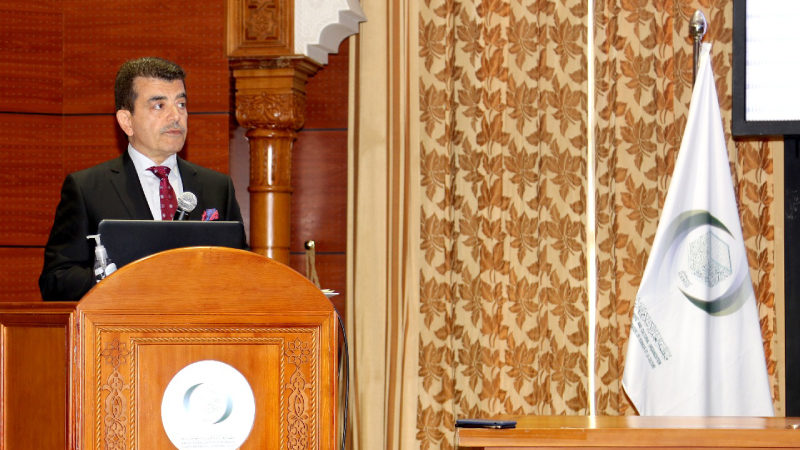
During this meeting, Dr.
AlMalik, who is also an immunologist and allergist, gave an awareness-raising
lecture to the staff members on Covid-19 and ways of prevention. He defined the
nature of the virus and identified its incubation period and the most common causes
of transmission and infection while reaffirming that avoiding crowds, ensuring
social distancing and properly washing hands with water and soap are likely to
decrease the spread of the virus. He also stressed the importance of repeatedly
drinking water and warm drinks, and eating healthy food and fruits.
Afterwards, Dr. AlMalik answered
the questions of some staff members concerning some drugs for increasing
immunity, the risk of the virus on children, the truth of some medications
prescribed for Covid-19 by using popular herb-based prescriptions. Dr. AlMalik
said that the best means to boost the immunity system is by eating healthy food
and fruits rich in vitamins while stressing that this disease is less dangerous
for children and young people except for cases with chronic diseases. He also
stated that herb-based remedies are unstudied and not approved.
In conclusion, ICESCO
Director General wished safety for all ICESCO’s staff members and beseeched
Allah Almighty to save the world from this pandemic as soon as possible.
The Director
General of the Islamic Educational, Scientific and Cultural Organization
(ICESCO), Dr. Salim M. AlMalik, refuted all the slanders and falsehoods are not
based on any factual or conclusive evidence posted on some websites and circulated
on social networks in the Kingdom of Morocco as part of a claim that the
Organization has laid off Moroccan staff members and substituted them with
nationals of other Member States.
In a
comprehensive and detailed note supplemented with facts, figures, graphs and
substantial proofs and evidence, Dr. AlMalik explained in detail the action
plan adopted by the Organization to achieve the progress of ICESCO, since he
has gained confidence of the members of the Extraordinary Session of the
General Conference (Makkah Al Mukarramah Area, 8-9 May 2019) to assume the
position of ICESCO Director General. He added that ICESCO had set up a number
of technical committees made up of the officials of ICESCO, specialized experts
and international administrative and financial consulting firms with
international reputation to conduct a thorough diagnosis of the Organization’s
financial and human resources as well as of its administrative system and
internal regulations.
After
examining the situation of the Organization, taking note of its executive
reports, considering its internal regulations, and meeting with ICESCO’s
concerned staff and officials, these committees and consulting firms presented
a comprehensive package of solutions, proposals and recommendations intended to
develop and reform the working mechanisms of ICESCO, and conduct structural
overhaul for the Organization. These recommendations were gradually implemented
in a balanced manner, in a bid to develop and upgrade ICESCO, meet the needs of
Member States in the fields of education, science and culture, and place ICESCO
at the international position it deserves so as to become a beacon of
international outreach.
The note
also states that the overall number of ICESCO staff members on 09 May 2019, the
day on which Dr. AlMalik assumed office as ICESCO Director General, was 165, of
whom 81% were Moroccan nationals. This number stands now at 148 staff members,
114 of them are Moroccan nationals accounting for 77% of the total staff. These
figures refute the claim that ICESCO is “liquidating” Moroccan staff members.
After the departure of the Moroccan staff members and the recruitment of new
Moroccan ones, the rate of Moroccan staff members inside ICESCO slightly
decreased by 4%.
This
situation is not to be compared with other international organizations which
usually witness shakes that affect staff members at every director change. According
to the note, the number of staff members who have definitively left work at
ICESCO since 09 May 2019 and received their end-of-service allowances are 59,
including 16 international staff members from twelve (12) different
nationalities, and 43 local staff members, including some members who are over
60 years old. The rest are older than 55 years and spent no less than fifteen
(15) years of work at ICESCO. By contrast, 39 new staff members have been recruited
since 09 May 2019, including 19 Moroccan nationals and 20 international staff
members from 12 nationalities, made up of highly skilled young staff aged
between 25 and 40 with outstanding expertise. Most of them have been appointed
at leading positions in vital sectors, not to mention that Member States demand
constantly that their expert nationals be recruited by the Organization.
In the same
vein, Dr. AlMalik underlined that the distribution of staff members among ICESCO
staff categories had been flagrantly imbalanced given the higher number of
local administrative staff members at the expense of the number of experts and
specialists in charge of the implementation of ICESCO’s programmes and
activities in Member States. The imbalance also affected the age categories of
the personnel which affected badly the Organization’s performance and its
ability to develop and renew itself.
The note
also reviewed 32 achievements scored by ICESCO since May 2019 following the
implementation of the developmental vision in light of the above-mentioned
diagnosis and guided by the solutions and proposals put forward by the
technical committees and consulting firms. The note also underscores that the
implementation of this vision that is designed to reform and develop the Organization’s
working methods received negative reactions from some parties which are hostile
to development and to the measures taken to this end through publishing
falsehoods and slanders, which are not based on any factual or conclusive
evidence, on some websites and social media in a desperate attempt to drag the
Organization into the internal affairs of the Seat Country and to disrupt the
excellent brotherly relationships between the Kingdom of Morocco and the
Kingdom of Saudi Arabia.
At the close
of the note, Dr. AlMalik reaffirmed the Organization is keen to promote and strengthen
relationships and ties with all Member States and their specialized and
official parties, and particularly with the Seat Country, the Kingdom of
Morocco, under the sound leadership of His Majesty King Mohamed VI who
continuously extends his unwavering support and dedicated attention to the
Organization following the example set by his late father His Majesty King
Hassan II, May Allah bless his soul, with whose sound vision it was made
possible to establish this Organization and grow under his blessed care.
The Islamic
World Educational, Scientific and Cultural Organization (ICESCO) upholds the
call of Mr. Tedros Ghebreyesus, WHO Director General, to the countries witnessing
the spread of Coronavirus (COVID-19) to suspend studies at schools and events
to curb the outbreak of the virus. Last week, ICESCO issued a statement wherein
it urged its Member States to take the quickest and most efficient measures to prevent
the spread of the virus and substitute face-to-face classes with the teaching
alternatives available in each country should educational institutions
temporarily shut.
In this
regard, ICESCO reiterates its complete willingness to support Member States’
efforts in such a way as to ensure permanent access to education and regularity
of teaching process in the best conditions.
ICESCO’s call
and initiative to promote scientific research by setting up a prize to reward
individuals or group who will find an effective cure or develop vaccine against
Coronavirus (COVID 19) received wider media coverage. In China, New China News
Agency (Xinhua), China Global Television Network and CNNM published
ICESCO’s two statements on the fight against Coronavirus in many languages. The
Anadolu Agency published the two news items in Arabic and Turkish. Other news
agencies followed suit, including Saudi Press Agency, Elaph and Sabq newspapers
in Saudi Arabia, Emirates News Agency (WAM) and Azerbaijan State News Agency
(AZERTAC).
For its
turn, Sky New Arabia website published the Organization’s statement about the
prize. In its report “what teachning alternatives to adopt should schools be closed
due to Coronavirus?”, the Qatari Aljazeera Mubasher website mentioned ICESCO’s
call to resort to teaching alternatives if schools must shut temporarily because
of the virus. The Egyptian DMC Channel, Al Ghad Satellite TV, the state TV
channel and the Tunisian channel Nessma have broadcasted the Organization’s
initiative.
A large
number of electronic news outlets in many countries published news about the
call and the initiative. These include Hespress, Al Omk, Al Youm 24, Scoop
Press, Nour 24, Al Maghreb Al Yaoum, Kech 24, Nafs, and Le 360 in Morocco; Youm
7, Al Ahram, Sada Al Balad, Shorouk News, Masrawy, Al Dostour, Al Bawaba News,
El Fagr, and Sout Alomma in Egypt; and Emarat
Al Youm and 24 in the United Arab Emirates.
The call and
the initiative were also met with great interest from a number of newspapers,
including Akhbar el-Yom in Egypt and Okaz, Al Yaum and Makkah in Saudi Arabia.
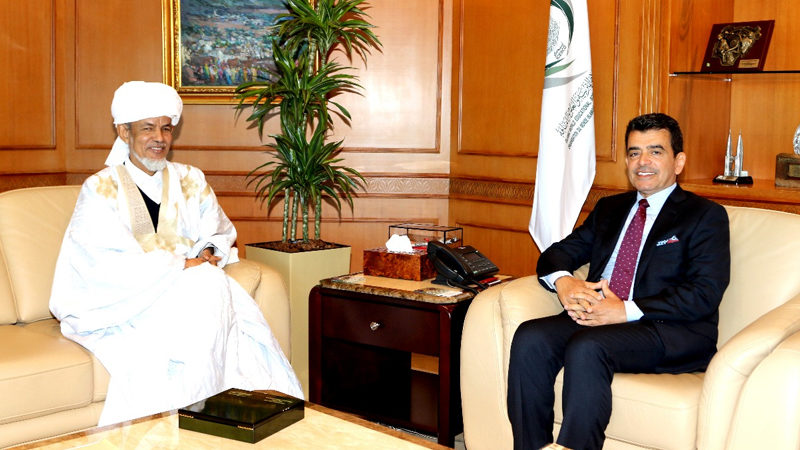
Dr. Salim M. AlMalik, Director General of the Islamic World Educational,
Scientific and Cultural Organization (ICESCO), at the Organization’s
headquarters in Rabat, received Sheikh Mohamed El Hafed Enahoui, President of
the African Ulema Forum and President of
the Islamic Cultural Gathering in Mauritania and West Africa.
At the outset of the meeting, Sheikh Enahoui congratulated Dr. AlMalik
on the Organization’s new vision which makes ICESCO a beacon of civilizational
outreach for Muslim countries, and on its openness to all world countries in
such a way as to serve Muslim communities in these countries and present the true
image of the Islamic civilization which advocates peace, coexistence and
tolerance.
Talks also focused on ICESCO’s initiatives and endeavour to contribute
to countering social and humanitarian challenges facing peoples of the Islamic
world, such as offering a US$ 200,000 in prize money to anyone who discovers an
effective cure or develops a vaccine against Coronavirus (COVID-19); calling
upon Member States to counter the danger of the spread of the Coronavirus and
ensure the use of the teaching alternatives available in each country in the
event the educational institutions were to be closed temporarily; and
reaffirming ICESCO’s full support to Member States’ efforts so as to ensure the
sustainability of the right to education and the regularity of the educational
process in the best appropriate conditions.
Sheikh Enahoui extended an invitation to Dr. AlMalik to attend the
upcoming session of the Conference on the Biography of the Prophet (As-Seerah
An-nabawiyyah), to be organized by the Islamic Cultural Gathering in Mauritania
and West Africa.