
ICESCO Holds Scientific Symposium on Cultural Rights, Contemporary Transformations

30 April 2026
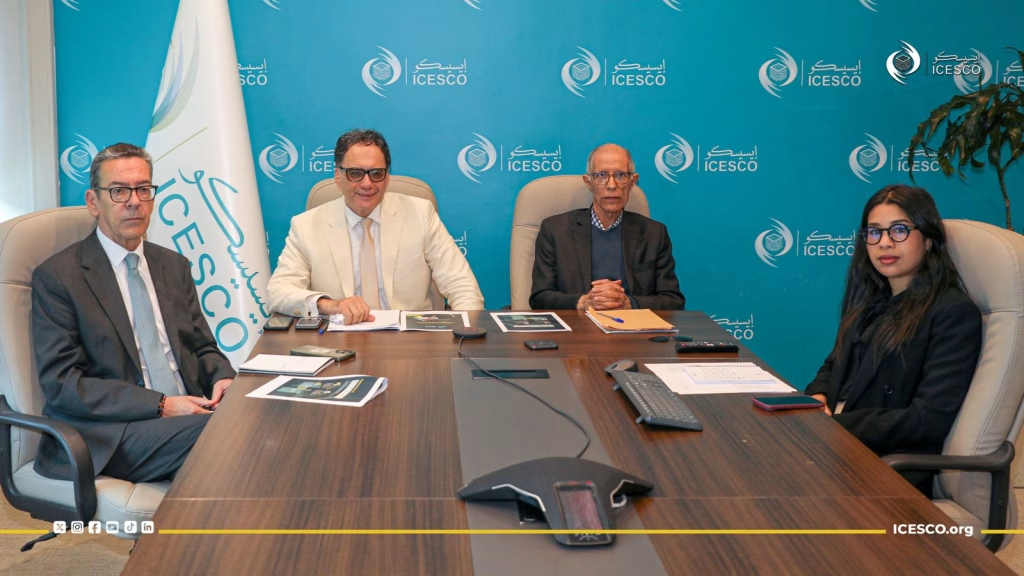
The Islamic World Educational, Scientific and Cultural Organization (ICESCO), as part of the International Forum “Culture for Rethinking the World,” held a scientific symposium titled “Cultural Rights in the Face of Contemporary Transformations: Stocktaking and Assessment,” in partnership with the European Center for Cultural Accessibility and the National Resource Center for Accessibility to Leisure and Culture (CEMAFORRE). The symposium was organized in the context of preparations for the launch of the “Draft Charter of Cultural Rights in the Islamic World,” being developed by ICESCO in cooperation with the European Center for Cultural Accessibility.
At the opening of the symposium, held via videoconference on Tuesday, 28 April 2026, Dr. Mohamed Zinelabidine, Head of the Culture Sector at ICESCO, explained that the Draft Charter forms part of a vision aimed at strengthening the recognition of cultural rights, which remain absent or limited in implementation in a number of Member States. He added that translating these rights into reality is contingent upon a series of commitments involving various officials and other stakeholders.
For his part, Mr. André Fertier, Director of CEMAFORRE, stressed that the effectiveness of rights is not achieved solely through legal texts and standards, but also through their capacity to safeguard shared human dignity. He noted that, despite the growing recognition of these rights, forms of cultural discrimination persist in a number of societies.
In turn, Dr. Édith Lecourt, Professor of Clinical Psychology at Paris Descartes University, stated that music therapy can constitute an effective tool for alleviating psychological suffering and addressing certain forms of human vulnerability. She pointed out that cultural accessibility is a decisive factor in expanding this field and integrating it into structured initiatives for treatment and training.
Dr. Bouazza Benachir, a member of the Institute of African Studies in Rabat, affirmed that activating cultural rights requires their mainstreaming through an approach grounded in dignity, diversity, and respect for others, alongside the development of cooperation through cross-border projects.
At the conclusion of the symposium, participants agreed that the rapid transformations the world is witnessing today call for a rethinking of a global framework that ensures the consolidation of cultural rights as one of the pillars of sustainable human development.