ICESCO Organizes International Conference in Uzbekistan on Challenges of Understanding Islam and Arabic in the Age of Globalization

9 November 2026
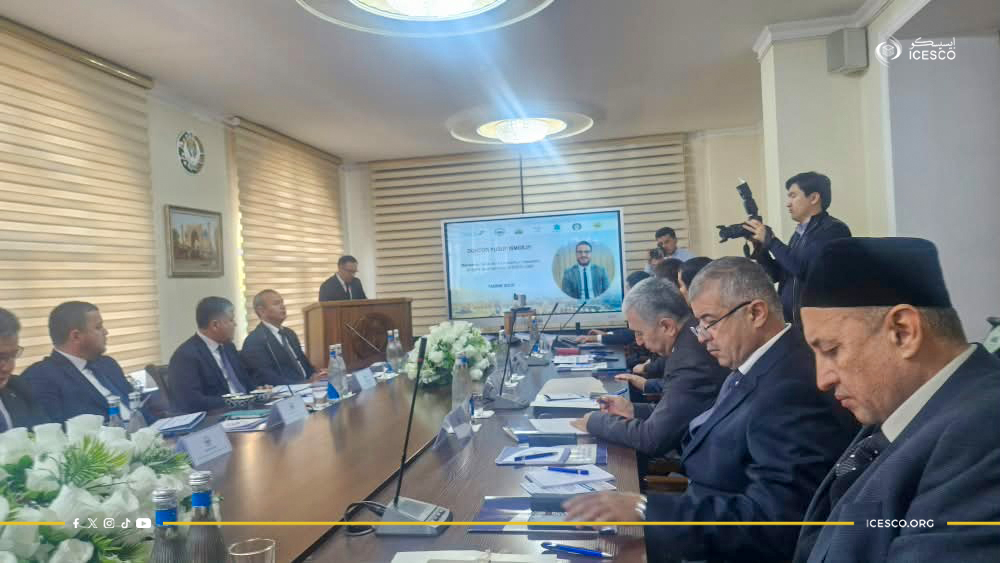
The Islamic World Educational, Scientific and Cultural Organization (ICESCO) participated in organizing the sixth international scientific conference, titled “Challenges of Understanding Islam and the Arabic Language in the Age of Globalization,” in cooperation with the International Islamic Academy of Uzbekistan and the ICESCO Chair for Islamic Civilization hosted by the Academy. The event brought together a distinguished group of scholars, researchers, and representatives of universities, centers, and scientific institutions from several countries.
At the opening session of the conference, held on 5 November 2026 in Tashkent, the capital of Uzbekistan, Dr. Youssef Ismaili, Head of the Language Training Division at ICESCO’s Center of Arabic for Non-Arabic Speakers, delivered virtual welcoming remarks. He commended the ongoing cooperation with the International Islamic Academy of Uzbekistan and the efforts of scientific institutions to advance the Arabic language, develop research, and strengthen academic exchange among researchers.
Dr. Ismaili, representing ICESCO, then delivered a presentation titled “The Role of Arabic Language Education in Promoting a Proper Understanding of Islamic Concepts among Non-Arabic Speakers.” He highlighted the importance of Arabic as a gateway to understanding Islamic concepts within their linguistic and cultural contexts, stressing that its teaching should not be limited to acquiring vocabulary, structures, and communication skills, but should also enable learners to engage thoughtfully with original texts and sources. He further underscored the need to develop curricula and teaching materials, train teachers, and use digital technologies and artificial intelligence responsibly, while verifying the reliability of content and consulting specialists on technical academic matters.
The conference featured speakers representing institutions from Uzbekistan, Türkiye, Egypt, Kazakhstan, and Indonesia. Their presentations addressed the analysis of Islamic sources, countering extremism, religious education, Islamic finance, civilizational heritage, and the impact of globalization on awareness and understanding.