Disclaimer: You are using Google Translate. The ICESCO is not responsible for the accuracy of the information in the translated language .

your opinion

User Feedback

Overall, how satisfied are you about the website?

    [uacf7_star_rating* rating class:rating_stars icon:star1 "default"]

    Extremely Dissatisfied
    Extremely Satisfied


    ICESCO Condemns the Attack on the City of Es-Semara and Reaffirms Its Solidarity with the Kingdom of Morocco

    The Islamic World Educational, Scientific and Cultural Organization (ICESCO) strongly condemns the attack targeting the city of Es-Semara in the Kingdom of Morocco, the Organization’s host country.
    ICESCO reaffirms its full solidarity with the Kingdom of Morocco and its support for the unity and territorial integrity of the Kingdom, as well as for all efforts aimed at preserving its sovereignty, security, and stability.

    In this regard, ICESCO reiterates its categorical rejection of all forms of violence and terrorism and calls for upholding the values of peace, dialogue, and fraternity, which constitute the essence of our true Islamic religion.

    ICESCO Launches “Artificial Intelligence for All” Initiative

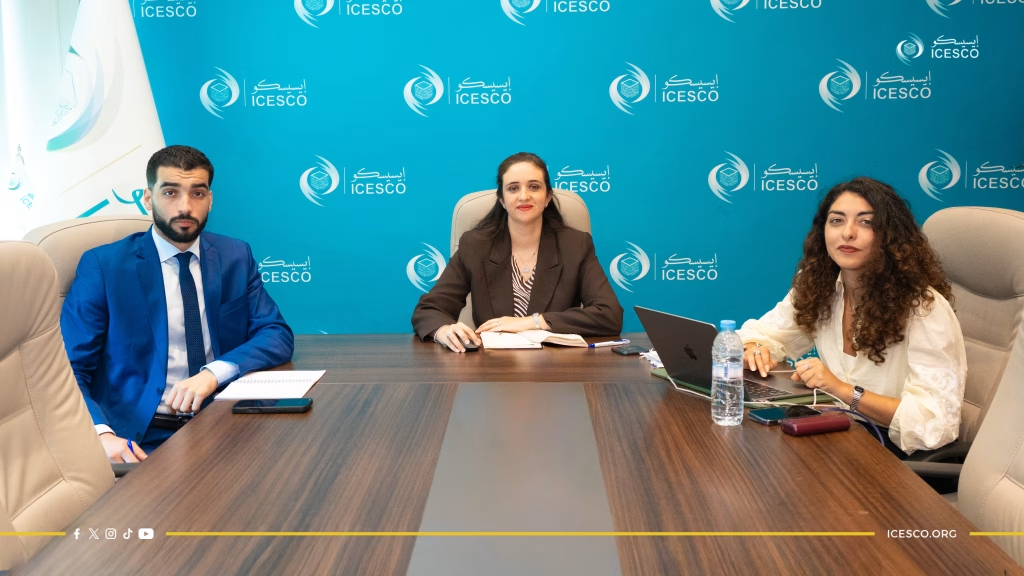
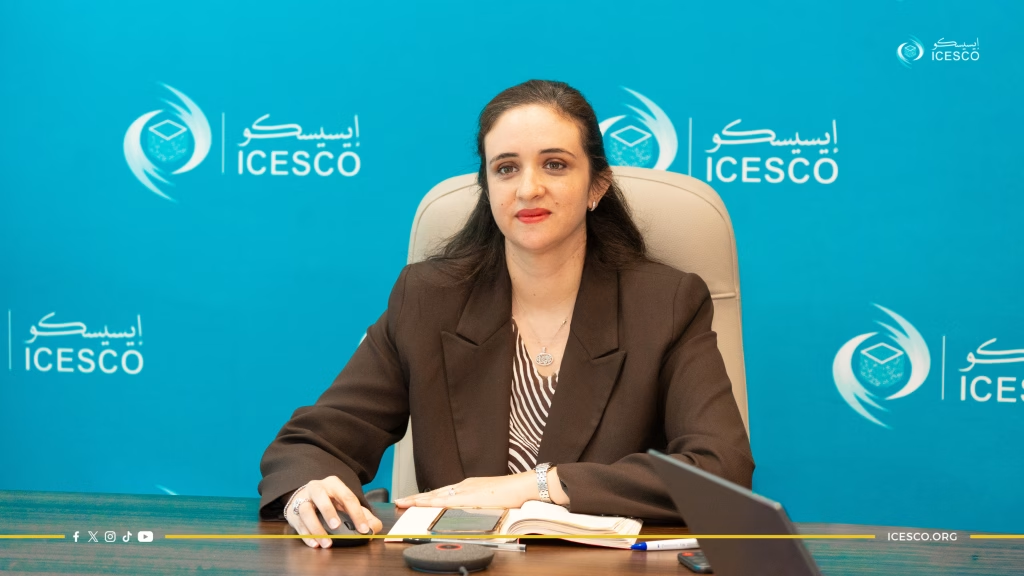
    The Islamic World Educational, Scientific and Cultural Organization (ICESCO) launched the “Artificial Intelligence for All” initiative during a symposium organized by the Organization’s Science and Environment Sector under the title “Artificial Intelligence for All: Inclusive AI for Communities, Sectors, and Skills.” The initiative aims to strengthen the capacities of professionals in the field and develop solutions to the challenges posed by artificial intelligence. The symposium brought together 67 experts and specialists in modern technologies to discuss mechanisms for mainstreaming artificial intelligence applications across the Islamic world.

    The opening address of the symposium, held virtually on Thursday 7 May 2026, was delivered by Dr. Kuanysh Yergaliyev, Head of the Science and Environment Sector at ICESCO. In his remarks, he underscored the importance of ensuring equal opportunities in benefiting from artificial intelligence technologies, while reviewing the Organization’s efforts to promote digital inclusion, innovation, and youth capacity-building.

    The first session of the symposium, moderated by Dr. Adel Smeda, expert at the Science and Environment Sector, addressed the opportunities and challenges of inclusive artificial intelligence. The second session, moderated by Dr. Issam Karimi, Expert at the Sector, focused on the role of low-code platforms in democratizing access to artificial intelligence and empowering non-technical users.

    ICESCO Director-General Honors Dr. Tayseer Dawas in Recognition of His Efforts as Chair of the Organization’s Executive Council During the Previous Session

    Dr. Salim M. AlMalik, Director-General of the Islamic World Educational, Scientific and Cultural Organization (ICESCO), received Dr. Dawas Tayseer Rashid Dawas, Assistant Secretary-General for Palestine and Al-Quds Affairs at the Organization of Islamic Cooperation (OIC), on the occasion of the conclusion of his term as Chair of ICESCO’s Executive Council. Dr. AlMalik expressed his deep appreciation for the efforts exerted by Dr. Dawas during his term and for his valuable contributions to supporting educational and cultural action in the service of the causes of the Islamic world.

    During the meeting, held on Thursday, 7 May 2026, at ICESCO headquarters in Rabat, Dr. AlMalik praised Dr. Dawas’ commitment and professionalism, as well as his contributions to advancing the Organization’s orientations and programs. He also commended his previous role as Secretary-General of the Palestinian National Commission for Education, Culture and Science, wishing him success in his current responsibilities.

    Dr. AlMalik emphasized that Dr. Dawas’ assumption of his new duties within the Organization of Islamic Cooperation would open broader prospects for coordination between the two organizations, enabling enhanced partnerships, the exchange of expertise, and the development of integrated action.

    For his part, Dr. Dawas expressed his appreciation for ICESCO and his pride in having chaired the Executive Council, praising the qualitative progress achieved by the Organization in terms of programs, initiatives, and international presence. He also conveyed the congratulations and regards of H.E. Mr. Hissein Brahim Taha, Secretary-General of the Organization of Islamic Cooperation, to Dr. Salim AlMalik on the occasion of submitting a recommendation to ICESCO’s General Conference to re-elect him as Director-General for a second term.

    At the conclusion of the meeting, Dr. AlMalik presented Dr. Dawas with a commemorative shield in recognition of his distinguished efforts during his term as Chair of the Organization’s Executive Council and in appreciation of his contributions to supporting ICESCO’s path and strengthening its institutional presence.

    The meeting was attended on behalf of ICESCO by Dr. Salim Al-Habsi, Director of the General Secretariat of National Commissions and Conferences, and Mr. Mohamed Hedi Shili, Head of the Division of Legal Affairs and International Standards.

    ICESCO, Saudi Ministry of Culture Discuss Progress on Illustrated Dictionary of the History of Arabic Calligraphy Project

    Dr. Salim M. AlMalik, Director-General of the Islamic World Educational, Scientific and Cultural Organization (ICESCO), held a meeting via videoconference on Thursday, 7 May 2026, with Dr. AlBara AlAuhali, Deputy Minister of Cultural Strategies and Policies at the Saudi Ministry of Culture, and Dr. Abdullah Hamidaddin, Assistant Secretary-General for Scientific Affairs at the King Faisal Center for Research and Islamic Studies, to discuss the progress achieved in the joint project for the Illustrated Dictionary of the History of Arabic Calligraphy.

    The discussions focused on the level of progress attained in the project, particularly with regard to the preparation of a scientific framework documenting the most prominent sources of Arabic calligraphy in the Islamic world, including manuscripts, inscriptions, artistic panels, and other materials, in order to present this civilizational heritage in a rigorous scholarly format that highlights its evolution and distinctiveness. The meeting also addressed a proposal to organize a scientific workshop at ICESCO headquarters in Rabat, with the participation of researchers, experts, and specialists in the art of Arabic calligraphy.

    In this regard, Dr. AlMalik emphasized that this major cultural project aims to consolidate the authenticity of Arabic calligraphy and highlight its uniqueness, independence, and distinction within its civilizational context. He further noted that the project constitutes one of the reference initiatives with profound impact in the Islamic world, as it will contribute to preserving and documenting this art through an illustrated scientific dictionary comprising three volumes.

    Dr. AlMalik added that ICESCO continues to work seriously and in close coordination with its partners on the project, explaining that current efforts include the preparation of a guidebook on the project and the formulation of the titles of the three volumes. He also proposed launching the project from ICESCO headquarters in Rabat in the presence of His Highness Bader bin Abdullah bin Farhan Al Saud, Minister of Culture of the Kingdom of Saudi Arabia, which would provide the project with momentum commensurate with its significance.

    For his part, Dr. AlBara AlAuhali stressed the particular importance of the dictionary, as it seeks to affirm the authenticity, uniqueness, and independence of Arabic calligraphy, and to highlight its distinction as an art form in its own right rather than one derived from other scripts. He also underscored the importance of completing the project within the established timeframe.

    Meanwhile, Dr. Hamidaddin delivered a presentation on the project and its scientific and intellectual dimensions, highlighting that the dictionary seeks to demonstrate the role of Islam as a principal driver in the development and spread of Arabic calligraphy.

    During the meeting, ICESCO was represented by Dr. Abdelilah Benarafa, Deputy Director-General; Dr. Mohamed Zine El Abidine, Head of the Culture Sector; Dr. Ahmed AlBanyan, Director of the Translation and Publishing Center; Dr. Idham Hanash, Director of the Center for Calligraphy and Manuscripts; Dr. Sally Mabrouk, Director of the Office of the Director-General and Supervisor of the Strategy and Institutional Excellence Sector; and Dr. Magdi Haji Ibrahim, Director of the Center for Arabic for Non-Arabic Speakers.

    ICESCO Executive Council Recommends Re-election of Salim AlMalik as Director-General of Organization for Second Term

    The Executive Council of the Islamic World Educational, Scientific and Cultural Organization (ICESCO) recommended the renewal of the mandate of Dr. Salim M. AlMalik as Director-General (DG) of the Organization for a second term. The Council decided to submit the recommendation to the Organization’s General Conference, which will be held in Kazan, Tatarstan, on 13 and 14 May 2026. The recommendation was made during the proceedings of the 46th session of the Executive Council, held in person at the Organization’s headquarters in Rabat and remotely, with the participation of representatives from 44 Member States.

    The Kingdom of Saudi Arabia, the candidate’s country, had expressed its wish to reappoint Dr. AlMalik for a second term, and this nomination was supported by 51 member states.

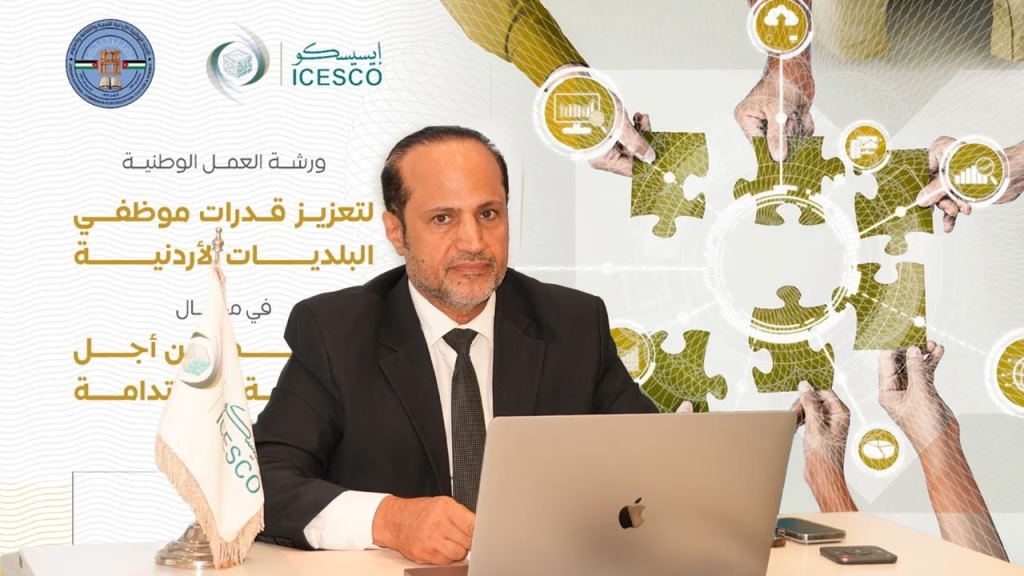
    At its meeting, which commenced on the morning of Wednesday, 6 May 2026, the Council adopted the decisions and projects submitted by the Organization’s General Directorate. The meeting also witnessed the election of Dr. Nawaf Al-Ajarmeh, Secretary-General for Educational and Technical Affairs at the Ministry of Education of the Hashemite Kingdom of Jordan, as President of the Executive Council, with Kazakhstan elected Vice-President and Côte d’Ivoire elected Rapporteur.

    The Council’s working sessions also saw the adoption of the Executive Report on ICESCO’s Activities for 2025, the Organization’s Financial Reports for 2024, the Report on Member States’ Contributions to ICESCO’s Budget for 2024, proposal to amend the contribution rates of Member States to the ICESCO budget, and the Draft Strategic Plan and Budget of the Organization (2026-2029), in addition to the adoption of measures related to improving the collection of Member States’ contributions and arrears.

    The sessions also included presentations delivered by a number of sector heads and directors of ICESCO centers and departments on the ICESCO Goodwill Ambassadors Program, the strategic partnership between ICESCO and the Republic of Azerbaijan to support and rehabilitate educational infrastructure in the Syrian Arab Republic, as well as Baku Declaration concerning the analytical study on the ICESCO Artificial Intelligence Index for the Islamic world, and the ICESCO Program to Support the Removal of Heritage Sites from the List of World Heritage in Danger.

    In his address during the closing session, the ICESCO DG commended the enthusiasm and proactive spirit demonstrated by the members of the Executive Council, noting that such commitment places a renewed responsibility on the Organization to fulfill its noble goals. He also expressed his appreciation for the confidence that the Member States continue to place in ICESCO’s General Directorate.

    ICESCO Holds Seminar on Social Diplomacy at Rabat International Publishing and Book Fair

    The pavilion of the Islamic World Educational, Scientific and Cultural Organization (ICESCO) at the 2026 Rabat International Publishing and Book Fair hosted, on Tuesday 5 May 2026, a series of cultural and intellectual activities aimed at promoting cultural dialogue, fostering discussion on societal and intellectual issues, and highlighting the role of culture in building bridges between peoples and expanding avenues of civilizational understanding.

    In this context, an intellectual seminar on “Social Diplomacy” was held at the pavilion, moderated by Dr. Sally Mabrouk, Director of the Office of the Director-General and Supervisor of the Strategy and Institutional Excellence Sector. In her opening remarks, she stressed that the concept of social diplomacy is gaining increasing importance in light of the rapid transformations taking place worldwide, which necessitate the development of communication tools and greater openness to societies, particularly among youth.

    The seminar featured contributions from Dr. Yousra Bint Hussain AlJazairy, Chair of the Cultural Committee of The Group of Spouses of Arab Ambassadors and Heads of International Organizations accredited to the Kingdom of Morocco; Dr. Mohamed Zine El Abidine, Head of the Culture Sector at ICESCO; and Ambassador Khalid Fathalrahman, Director of the Center for Civilizational Dialogue at the Organization. Their interventions addressed the various dimensions of social diplomacy as a new mechanism for positive influence and for reshaping the relationship between institutions and societies.

    At the outset of her intervention, Dr. Yousra AlJazairy emphasized that social diplomacy must today reassess its tools and working methods, noting that the coming decade “will not be forgiving” if it remains confined to traditional and elitist approaches. She called for greater openness to the digital generation and its engagement in initiatives and programs, affirming that diplomacy can no longer operate in isolation from the social and technological transformations that are reshaping patterns of interaction and influence.

    For his part, Dr. Mohamed Zine El Abidine underscored that culture remains the primary vehicle for any successful social diplomacy project, explaining that the challenge lies not only in addressing the attraction to foreign cultures but also in developing a renewed cultural vision rooted in the civilizational heritage of the Islamic world and presented in a contemporary and appealing manner. He added that ICESCO has, in recent years, accumulated a range of relevant initiatives and conferences that are likely to yield positive outcomes in the long term.

    Ambassador Khalid Fathalrahman highlighted that society constitutes the foundation of diplomatic action, while culture represents its loftiest expression. He noted that changing stereotypes about the Other can only be achieved through education, culture, and mutual openness. He also pointed out that one of the major challenges facing social diplomacy is the persistence of a form of Western centrality in shaping perceptions and standards, which calls for the development of more balanced and equitable approaches.

    The seminar also featured an intervention by Dr. Salim M. AlMalik, Director-General of ICESCO, who addressed the dimensions of social diplomacy and its role in strengthening the cultural and human presence of institutions and international organizations.

    ICESCO, Palestine Discuss Support for Inscription and Protection of Palestinian Heritage Sites

    Dr. AlMalik: “We Discussed Displaying Palestinian Artifacts at ICESCO Headquarters to Raise Global Awareness of the Importance of Their Protection”

    Dr. Salim M. AlMalik, Director-General of the Islamic World Educational, Scientific and Cultural Organization (ICESCO), received Mr. Hani Al-Hayek, Minister of Tourism and Antiquities of the State of Palestine, on Tuesday, 5 May 2026, at the Organization’s headquarters in Rabat. The meeting aimed to discuss ways to enhance joint cooperation in heritage preservation and valorization, the protection of Palestinian cultural property, and support for the inscription of a number of heritage sites and elements in Palestine on ICESCO’s Islamic World Heritage List.

    At the outset of the meeting, Dr. AlMalik reviewed ICESCO’s vision, programs, and initiatives within its fields of competence, with a particular focus on the Organization’s efforts to inscribe the heritage of the Islamic world and to safeguard cultural property and heritage elements from damage, looting, and illicit trafficking. This is to be achieved through documentation, capacity-building, and the use of the latest technologies in this field.

    In this context, Dr. AlMalik reaffirmed ICESCO’s openness to organizing training programs and specialized workshops on safeguarding cultural heritage. Additionally, the Director-General expressed willingness to launch capacity-building programs for experts and professionals engaged in heritage preservation in Palestine, whether within the Palestinian territories or in the Arab Republic of Egypt, given its advanced expertise and experience in this domain.

    Dr. AlMalik also proposed the possibility of hosting Palestinian artifacts at ICESCO headquarters in Rabat as part of an initiative aimed at showcasing Palestinian civilizational heritage and bringing its spiritual, human, and cultural dimensions closer to the public, thereby contributing to highlighting the richness of this heritage and enhancing international awareness of the importance of its protection and preservation.

    For his part, the Palestinian Minister of Tourism and Antiquities stressed the importance of safeguarding Palestinian cultural properties and archaeological sites, noting that many historical and archaeological sites have suffered partial or total destruction due to military operations and successive wars, particularly the recent war on the Gaza Strip.

    Mr. Al-Hayek added that Palestine has developed innovative models in heritage management and launched the “5,000 Years of History” program, through which hundreds of historical artifacts have been exhibited in several Arab and European capitals. He also noted his Ministry’s aspiration to build institutional cooperation with ICESCO and its experts to strengthen national capacities in this field.

    The two sides agreed during the meeting to sign a Memorandum of Understanding in the near future, outlining a joint cooperation framework for the implementation of programs and projects and the launch of bilateral initiatives in the field of heritage preservation and valorization.

    Dr. Abdelilah Benarafa, Deputy Director-General; Mr. Osama Heikal, Head of the Media and Communication Sector; Dr. Mohamed Zin El Abidine, Head of the Culture Sector; and Dr. Nidal Abu Zahri, Director of the Administrative Operations Department, represented ICESCO during the meeting.

    ICESCO Holds Regional Workshop on Employing AI in Teaching Arabic Language

    The Islamic World Educational, Scientific and Cultural Organization (ICESCO) held a regional workshop on the use of technology and artificial intelligence systems in teaching the Arabic language, in cooperation with the Hamdan Bin Rashid Al Maktoum Foundation for Medical and Educational Sciences. The workshop brought together 200 male and female trainees, both in person and via videoconferencing, from among education professionals working in the field of teaching Arabic to non-Arabic speakers in 15 countries across Africa, Central Asia, and Southeast Asia.

    The workshop was held on 29 and 30 April 2026, at the Mishkat Hall at ICESCO Headquarters in Rabat. It formed part of a programme aimed at developing the competencies of professionals engaged in teaching Arabic to non-Arabic speakers and enhancing the use of modern technological tools and artificial intelligence to advance educational practice.

    During the workshop, Dr. Mustafa Jaghboub, an expert in educational technology, analyzed and assessed the gap between linguistic accuracy and pedagogical suitability in the outputs of Large Language Models based on artificial intelligence. He presented approaches to bridging this gap through the adoption of precise prompt engineering, ensuring more effective and efficient use of technology in the service of language education.

    The expert also supervised practical sessions that enabled participants to train on transforming raw, preliminary artificial intelligence outputs into educational resources suited to different learner levels, using the “Mubeen” platform.

    It is worth noting that this workshop is part of the eighth edition of the “Mishkat Educational Leadership” programme for the 2025–2026 academic year, implemented by ICESCO in partnership with the Hamdan Bin Rashid Al Maktoum Foundation, with academic cooperation from Sultan Moulay Slimane University in Beni Mellal.

    ICESCO Youth Peace Ambassadors Launch Social Media Campaign to Promote the Values of Peace

    As part of its ongoing efforts to promote the values of peace, dialogue, and mutual understanding, the Islamic World Educational, Scientific and Cultural Organization (ICESCO) has launched a digital media campaign on social media platforms titled “ICESCO Youth 4 Peace.” The campaign brings together 227 ICESCO Youth Peace Ambassadors representing 81 countries from within and beyond the Islamic world.

    Supervised by ICESCO’s Social and Human Sciences Sector, the campaign aims to promote young people’s voices and strengthen their efforts to advance peace and peaceful coexistence, particularly amid escalating conflicts in several regions of the world. It leverages digital technologies as effective platforms for disseminating the values of peace across societies and cultures.

    The campaign includes the production of a series of videos by ICESCO Youth Peace Ambassadors, in cooperation with ICESCO’s Media and Communication Sector, calling for the promotion of peace and dialogue. The videos focus on shared values that unite humanity and underscore that the path to prosperity and well-being lies in fostering dialogue, coexistence, and tolerance within societies.

    The campaign can be followed on the Organization’s official social media pages through: #ICESCOYouth4Peace

    This campaign builds on the “Call for Peace” launched by ICESCO Youth Peace Ambassadors, whose voices emphasized the need for collective commitment to the values of peace through constructive dialogue and diplomacy in order to develop sustainable solutions based on respect for diversity.

    ICESCO Organizes 57 Activities at Its Pavilion During the 31st Rabat International Book and Publishing Fair

    The Islamic World Educational, Scientific and Cultural Organization (ICESCO) is participating with a dedicated pavilion in the 31st edition of the International Book and Publishing Fair (SIEL), organized by the Ministry of Youth, Culture and Communication of the Kingdom of Morocco in Rabat, under the High Patronage of His Majesty King Mohammed VI, may God assist him. The Fair was inaugurated on Thursday, 30 April 2026, by His Royal Highness Crown Prince Moulay El Hassan.

    Running until 10 May, this edition features broad international cultural participation, with 61 countries and 891 exhibitors, France as guest of honor, and a celebration of the traveller Ibn Battuta, coinciding with the designation of Rabat as World Book Capital for 2026.

    ICESCO’s pavilion will serve as an open space for cultural dialogue and intellectual exchange through the organization of more than 57 activities and events in Arabic, French and English throughout the Fair. These activities include intellectual seminars, literary encounters and poetry readings, with the participation of a distinguished group of intellectuals, thinkers and writers from the Organization’s Member States and beyond.

    The pavilion also hosts a diverse exhibition of ICESCO publications, including books and studies in the fields of education, science, culture, media and the humanities, in addition to informational materials highlighting its flagship programmes and initiatives.

    The pavilion has been equipped with modern display screens broadcasting audiovisual content that documents ICESCO’s activities and showcases its areas of work and projects in support of intellectual and cultural development in the Islamic world.

    The pavilion will witness broad participation by ICESCO staff, including heads of sectors, divisions and specialized centres, alongside a number of academics and supervisors of ICESCO chairs, who will enrich the pavilion’s through specialized presentations and meetings reflecting the diversity of the Organization’s fields of action.

    ICESCO will accompany its participation with media coverage through its official platforms, reinforcing its cultural presence and making its pavilion a prominent destination within the Fair’s activities and a showcase for its mission to support knowledge, dialogue and cultural exchange.