
ICESCO Honored with International Knowledge Management Award, to Receive Distinction in Vienna
20 November 2026
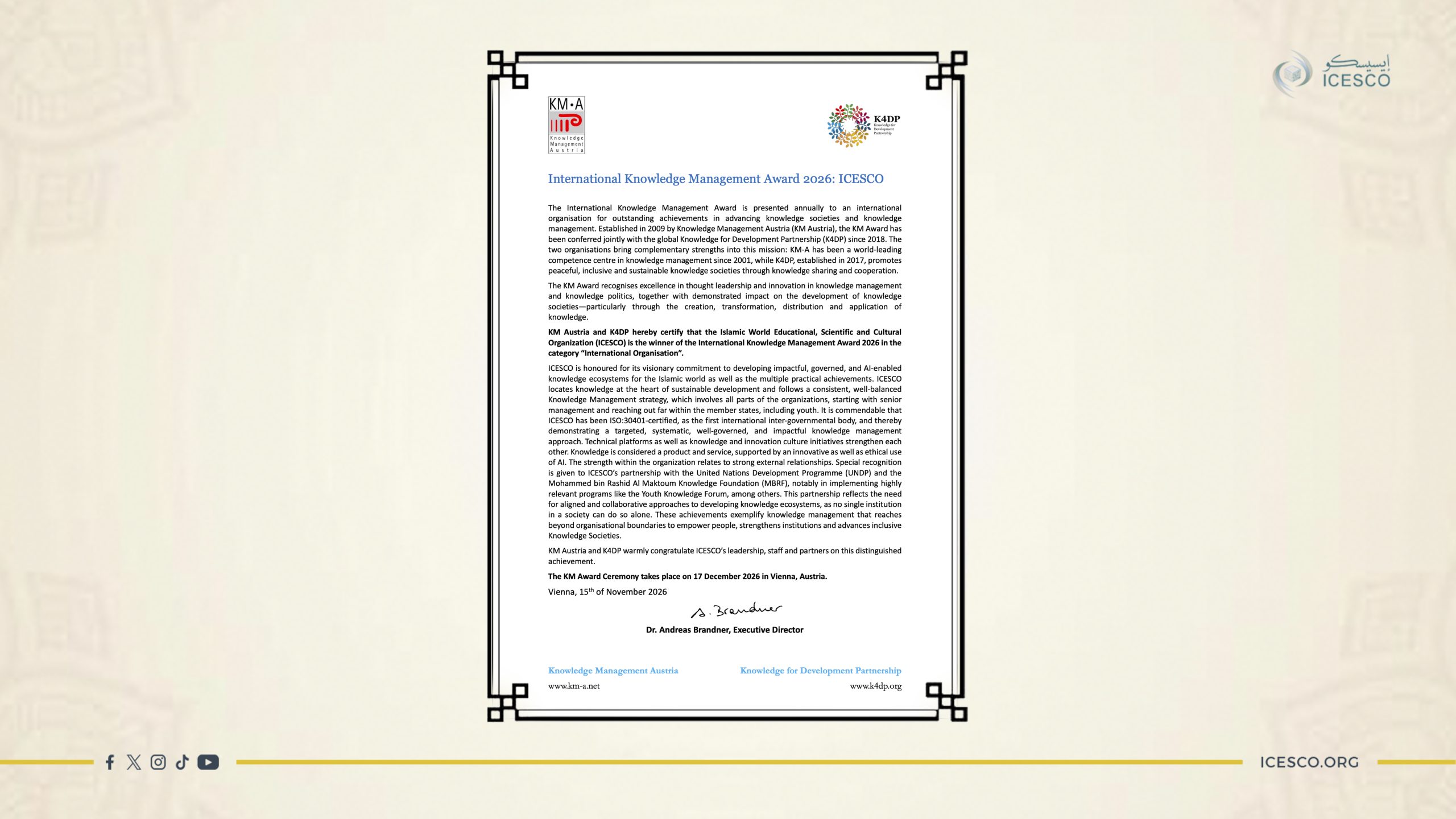
The Islamic World Educational, Scientific and Cultural Organization (ICESCO) has won the 2026 International Knowledge Management Award in the “International Organization” category, in recognition of its leadership in integrating knowledge and artificial intelligence into its institutional work and expanding opportunities for knowledge exchange and learning among its 53 Member States. The award is set to be presented in Vienna, Austria, on 17 December 2026.
The award is presented by Knowledge Management Austria (KM Austria), in partnership with the Knowledge for Development Partnership (K4DP). The two awarding bodies commended ICESCO for integrating knowledge management into its institutional governance and for its efforts to expand knowledge cooperation among Member States and engage young people in this process.
Among the key achievements recognized by the award is ICESCO’s certification under ISO 30401, the international standard for knowledge management systems, making it the first intergovernmental organization to obtain this certification. This achievement reflects the integration of knowledge management into the Organization’s operating procedures and decision-making mechanisms.
This recognition is the outcome of an institutional transformation led by ICESCO Director-General Dr. Salim M. AlMalik to consolidate the role of knowledge in decision-making and strengthen innovation and cooperation among Member States. The transformation is guided by the Organization’s Knowledge Management Strategy for 2025-2030, which links knowledge production and preservation with its exchange and use in decision-making, while promoting knowledge leadership within the Organization.
The strategy is embodied in tools serving Member States, including the HiveFlow platform, which facilitates collaboration and knowledge exchange, and the Islamic World Resilience Portal, which provides knowledge and foresight tools covering 12 sectors across Member States and supports the development of evidence-based policies and programs in resilience and development.