ICESCO Concludes Its Ramadan Legal Series with Webinar on Protection of Cultural Property in the Digital Age

14 March 2026
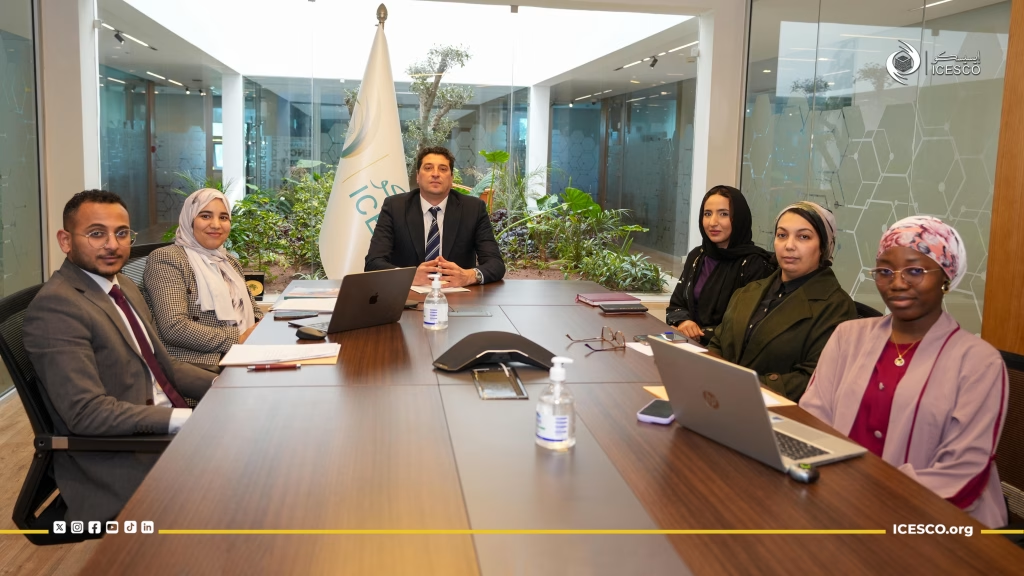
The World Islamic Educational, Scientific and Cultural Organization (ICESCO) concluded its Ramadan Legal Series on Friday, March 13, 2026, by organizing its third and final scientific seminar, titled “Protection of Cultural Property in the Digital Age: Legal Challenges and Solutions.” The event saw the participation of experts and academics specializing in law, cultural heritage, and archaeology.
The webinar, held via videoconference, aimed to examine the growing challenges posed by digital transformation to heritage protection. It considered the opportunities for documentation and preservation offered by technological development, against the backdrop of increasing risks related to the facilitation of illicit trafficking, smuggling, and forgery of cultural property.
The webinar commenced with an opening address by Mr. Mohamed Hedi Shili, Director of the Legal Affairs and International Standards Department at ICESCO. Participants discussed the roles of digital platforms, social media, and e-commerce markets in the emergence of new methods for displaying and selling artifacts illegally, which presents challenges to national legislation and international mechanisms concerned with protecting humanity’s heritage.
Moderated by Dr. Asmaa Mehidioui, expert at the Legal Affairs and International Standards Department, the seminar featured presentations covering comparative dimensions and national experiences. Mr. Tchan Issifou Ibrahim, a legal expert from the Republic of Benin, presented the findings of a comparative study on African legislation to combat the illicit trafficking of cultural property, highlighting the legal and institutional challenges in the context of digital transformations.
Dr. Anas Al Khabour, Associate Professor of Archaeology at Lund University in Sweden, presented the results of a similar study on Asian countries, noting the disparity of legal frameworks, the difficulties of tracing, and the relative weakness in international coordination.
For his part, Dr. Badr bin Nasser Al-Khamisi, Director of the Legal Department at the Ministry of Heritage and Tourism in the Sultanate of Oman, presented the Omani experience in protecting cultural property, explaining the most prominent methods of smuggling and illicit trafficking, including the exploitation of digital technologies and platforms to market artifacts outside legal channels. In turn, Professor Fethi Jerray, Professor of Archaeology and Cultural Heritage at the University of Tunis, focused on the potential of digitization and artificial intelligence in the documentation, archiving, and recording of cultural property.
At the close of the webinar, the participants emphasized the necessity of updating legal and institutional frameworks to keep pace with rapid digital transformations, enhancing international and regional cooperation, and exchanging expertise to combat the illicit trafficking of cultural property and protect heritage.